Sage 300 vs. Sage X3: Which One Fits a Growing Business?
Compare Sage 300 and Sage X3 across financial management, manufacturing, inventory, and scalability to identify which ERP solution best supports your current operations and future growth.


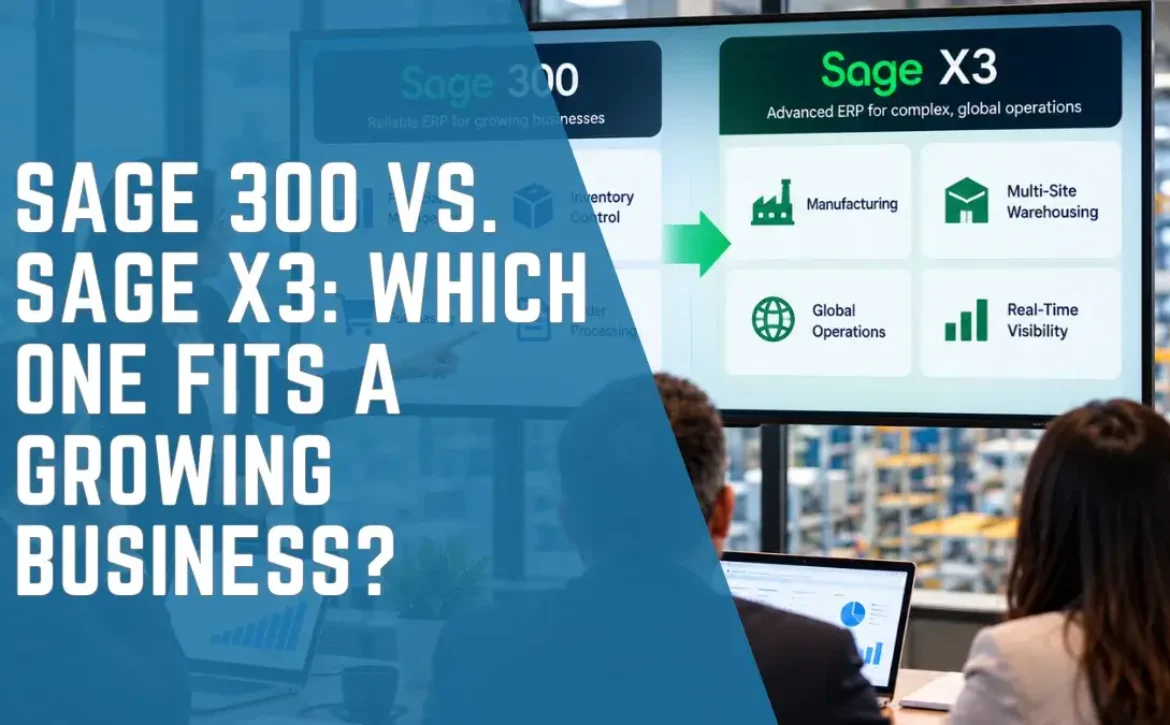
Compare Sage 300 and Sage X3 across financial management, manufacturing, inventory, and scalability to identify which ERP solution best supports your current operations and future growth.
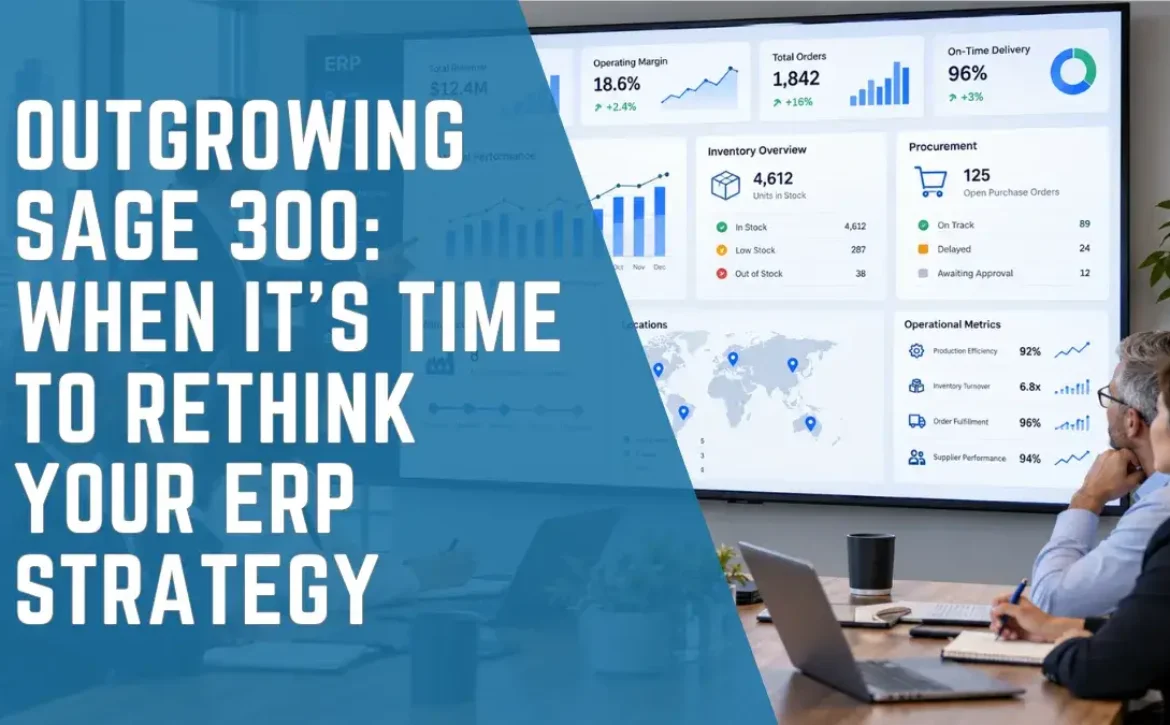
Identify the warning signs that your business is outgrowing Sage 300, understand common ERP system limitations, and determine when upgrading can improve efficiency, scalability, and performance.

Sage 300 and QuickBooks are both powerful accounting solutions, but they serve different business needs. This guide compares their features, pricing, scalability, and usability to help you choose the right platform for your organization.

Discover the key Sage 300 features that help businesses improve financial management, reporting, inventory control, and operational efficiency. This guide explores Sage 300 capabilities, benefits, and how it compares with modern ERP alternatives like Sage Intacct, Acumatica, and Sage X3.
 If you’re working with an ERP consulting firm such as IWI Consulting Group, you have access to some of the best minds in the ERP world. Your consultants want the best for you and they want your Sage EM (formerly known as Sage X3) or Sage 300cloud (formerly known as Sage 300) system to become an integral part of your business. In order for you to really gain the maximum benefit from your ERP consulting project, these tips will help you use your system in new and innovative ways.
Data found in Sage ERP can be used to build, refine, and support your company’s short and long-term strategic plans. Be sure that the software chosen for your company scales with your growth and enables you to add functions and modules, as required. Sage-based software is ideal for long-term growth. There are many modules—such as HRMS, CRM, and more—that can be added to build out a bigger, better system over time.
The information derived from your ERP system is only as accurate as the data inputted into the system itself. Data policies and guidelines help set standards and expectations for how and who can enter data into the system. Choose someone on your team to become the data captain to monitor and maintain data policies and “police” the use of the system. The cleaner the data inputted into the system, the more accurate your reports will be
Standard workflows and process maps take the guesswork out of procedures and enable institutional knowledge to be transferred with ease. Training, implementation, and use of Sage EM (formerly known as Sage X3), Sage 300cloud (formerly known as Sage 300) and other systems are easier when the information, process, and procedures are written down. Such documents can be shared quickly and easily with anyone within the company for faster onboarding, training, and orientation. They can also enhance accountability, ensuring that everyone knows who is responsible for which portion of a process.
Don’t just send your employees into their new Sage ERP system without adequate training. Make time for training, and ensure that everyone knows how important it is to attend training. The more training you invest in, the better the use of the system, since employees will understand the many features and functions at their disposal.
Once your new Sage EM (formerly known as Sage X3) or Sage 300cloud (formerly known as Sage 300) system is in place, it’s time to assess the ROI. Identify areas where you were able to save money, time, or gain information from the system that helped you improve job functions, processes, or other aspects of your business. ROI is more than the direct return on investment. Indirect returns, such as time saved, errors avoided, and other benefits may also be included in your ROI calculations if desired.
A new ERP system such as Sage EM (formerly known as Sage X3) or Sage 300cloud (formerly known as Sage 300) offers many features. Accounting and financial management, sales and customer management, purchasing management, business intelligent, and more are all available. If you’ve been using another package to manage your business, you’ll be amazed at what Sage ERP offers.
At IWI Consulting Group, we provide businesses and nonprofit organizations with robust ERP packages such as Sage EM (formerly known as Sage X3) and Sage 300cloud (formerly known as Sage 300). With these ERP systems, you can gain business insights, manage your business more effectively, and improve efficiencies. For more information, visit IWI Consulting Group.
Sage 300 Cloud enables organizations to modernize legacy ERP environments while improving scalability, reporting, and operational efficiency. This guide explores migration strategies, challenges, and modern alternatives for CFOs and IT leaders.
Learn how management supply chain management helps manufacturers and distributors improve inventory control, procurement, production planning, and logistics. Discover how ERP software provides real-time visibility, automates workflows, reduces costs, and supports smarter business decisions across the supply chain.
Few companies wish to spend money on product integration solutions, but with Sage 300cloud (formerly Sage Accpac), your investment will pay for itself in terms of accurate, timely data that can be used to inform decision-making.
What could your company do with better business intelligence? That’s the question many manufacturers are asking themselves this year as they consider investing in integrated software solutions that will help each of their business areas work together efficiently.
The ever-increasing competition among global manufacturers has caused a revolution in how information is used in the industry. Today, manufacturers must produce quality goods at the lowest costs just as they did yesterday. But in order to achieve this objective, they must have accurate, timely data, and an easy way to get it. This improved business intelligence enables companies to make better decisions and improve the bottom line.
A white paper from IDG Research Services and Sage provides some insights into where manufacturers intend to put their money. Among those surveyed, 63 percent say that challenges to daily operations include collecting business insights to drive business decision-making.
Data has always been the lifeblood of the manufacturing process. Knowing costs at each level of the product cycle, understanding fixed and variable costs, and calculating supply chain variables that can increase profitability are all part and parcel of the manufacturer’s world.
But today, manufacturers want more than just the cost of the components of their widgets. They want to know not just the numbers, but how changes in one part of the system impact the whole. They want the flexibility to run models that help them gain insights into how costs impact profits. More importantly, they demand accurate data that can be used to inform decision-making.
Unsolved system integration challenges pose many risks for manufacturers. As more components are added to a system, there’s greater potential for error. Mistakes in data entry (and re-entry), for example, can lead to incorrect data. This data, if used to make decisions, can lead companies into poor decision-making that can negatively impact profits. Beyond poor decision making, every time data is re-entered into the system, it costs more money that could be much more useful invested elsewhere.
Today manufacturers are placing a priority on system integration so that they can gain a comprehensive, single view of the entire business. Although such investments may be substantial, they do pay off. Manufacturers who invest in systems integration see improvements as a result of the investment. Clearly, when product integration is comprehensive and accurate, it offers useful information that can improve business.
Among the manufacturers surveyed in the Sage study, 74 percent said they had made investments in integration. These investments took the form of integrating new technology with legacy systems so that they would gain a comprehensive, single view of the entire business.
Although such investments may be substantial, they do pay off. Every single one of the participants in the study who said they had invested in integration agreed that they saw improvements as a result of the investment. Clearly, when system integration is comprehensive and accurate, it offers useful information that can improve business.
One thing that many companies fail to consider as they examine ERP solutions is how easy they are to use. If solutions aren’t easy or intuitive, adoption within your company will be difficult, and the learning curve steep.
Among the many product integration solutions available for manufacturers, Sage 300cloud (formerly called Sage Accpac) offers an easy to use package for mid sized business. Users cite the quality of the data and ease of use as some of the top features for Sage 300cloud (formerly known as Sage 300).
Other features of Sage 300cloud (formerly known as Sage 300) cited by users as important to their business include:
Any investment made into software must provide a good return on investment. With Sage 300cloud (formerly known as Sage 300) and system integration challenges solved, your company will have access to instantaneous and accurate data from myriad systems. It’s systems integration that pays off.
For more information about Sage 300cloud (formerly known as Sage 300), Toronto-based IWI offers Sage solutions and more for your growing business. Talk to us today about solutions for business systems integration, supply chain visibility, CRM and more. Call Sage 300 Toronto-vendor IWI at 1-866-916-3851 today.
Inventory really is the lifeblood of sales and production processes within manufacturing and distribution companies. Therefore, it is important to have a sufficient stock to avoid lost sales and keep customers satisfied. At the same time, only carrying the necessary quantities of inventory avoids the need to pay extra carrying costs like taxes, insurance, security, and storage. In order to improve inventory control and management, it is important to understand the process and the three key facets of the process. These facets are distinct from one another and yet interconnected so understanding them all will lead to bettering the entire inventory management process using enterprise software to help get you to where you need to be as a business.
Physical inventory control is all about receiving, moving, stocking, and the physical control of inventory. This is typically an ongoing process with arrivals and departures occurring daily. Barcoding, consigning, and kit repackaging are all important parts of physical inventory control.
In addition, data entry is an important part of the physical side of inventory operations. All items must be tracked using enterprise software to ensure accurate and timely inventory data collection that is essential for success. Cycle counting is also necessary. This is a manual intervention that serves to check and verify that computerized data records match physical stock in terms of both quantity and location.
Unlike the control and movement emphasized by the physical process, systematic management is the emphasis of the planning process. Planning relies on varying rates of demand and methodologies. This involves right-sizing inventory that gets turned over reliably and is replenished frequently by avoiding stock-outs and lost sales in addition to avoiding trapping working capital in overages of pricey stock. Another aspect involves purchasing new inventory based on customer demand.
Data, just like the physical inventory process, should drive the stocking of inventory. Therefore, accurate data is essential and is driven by conscientious data entry using Sage 300 ERP, Sage ERP X3, or another enterprise software system. Systematic and preplanned approaches to replenishing inventory involve using information that is relevant to sales, finance, purchasing, production, and shipping/receiving. Enterprise software helps store and use this data efficiently.
Even with planning and physical inventory controls, it is still possible to have too much or too little inventory. Frequent occurrences of stock-outs and stock overages indicate inventory levels that lack optimization. Thanks to technology, inventory optimization systems now help with supply chain management by calculating where and when inventory should be deployed to fulfill predetermined objectives. By better classifying stocking levels according to past demand and improving demand forecasting for future use, these systems greatly assist in optimizing inventory.
Although mismatches between stock and demand cannot be entirely eliminated, they can be significantly reduced by forecasting more accurately and quickly. This allows the predetermined objectives (such as measureable reductions in inventory investment, increased customer satisfaction, maximized output, and cost containment) to be more within reach.
These processes come together to make up the important inventory cycle. All of them are improved with technology meant to handle many important facets of inventory management and data collection. Learn more about out IWI Consulting’s ERP system offerings: Sage X3 here and Sage 300cloud (formerly known as Sage 300) here.
Our small and dedicated team specializes in helping small-to-medium size Canadian businesses and non-profits select and adapt Enterprise Resource Planning (ERP), Customer Relationship Management (CRM), Human Resource Management (HRMS) and IT services. With IWI’s 15 years in business and 100 plus years of combined experience, IWI has helped hundreds of manufacturing, distribution, and financial service companies gain efficiency, grow, and lower their operating costs.
With the unique combination of industry knowledge and diverse technology expertise, IWI provides cost-effective solutions to help clients gain a competitive edge. As a Sage business partner, servicing the Greater Toronto Area, we support evaluation and implementation of operations and finance systems to optimize technology, ensuring high return on investment with a quick and painless transition to new software.