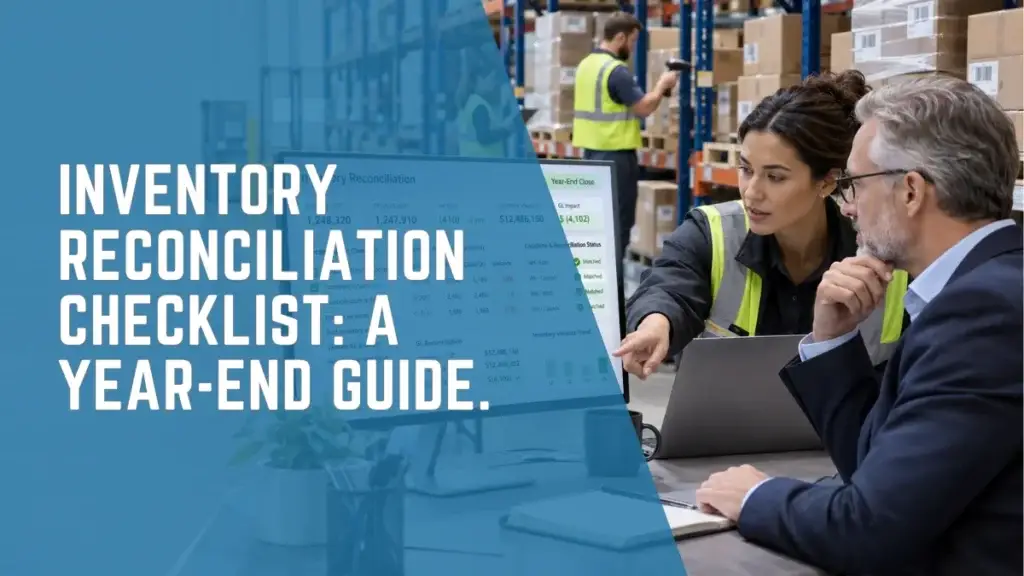
Prepared by IWI Consulting Group’s ERP advisory and implementation team.
Reviewed for operational and financial-control clarity. Updated November 23, 2026.
Inventory reconciliation is a financial and operational control that compares physical stock with ERP quantities, inventory values, subledger records, and general ledger balances. A complete reconciliation does more than correct a count. It explains differences, confirms valuation, records approved adjustments, and preserves evidence for management and audit review.
This guide gives CFOs, Controllers, finance teams, and operations leaders a practical 17-step process for year-end close. It also shows where recurring discrepancies can point to weak processes, master-data problems, integration gaps, or ERP limitations. For related planning, see IWI’s guidance on inventory turnover, inventory demand forecasting, and ERP warehouse management.
Inventory Reconciliation Checklist at a Glance
Use the following sequence as a year-end control checklist. The steps are grouped into five phases so teams can assign ownership, schedule work, and identify dependencies without treating each task as a separate project.
- Establish a clear inventory cutoff.
- Clean inventory records before the count.
- Complete the physical inventory count.
- Compare physical inventory with ERP records.
- Investigate material inventory variances.
- Review negative inventory.
- Validate inventory costing.
- Review purchase price variances and standard costs.
- Validate landed costs.
- Review manufacturing costs.
- Review obsolete, damaged, and slow-moving inventory.
- Reconcile inventory in transit and warehouse transfers.
- Review open purchase receipts.
- Review open customer shipments.
- Reconcile the inventory subledger.
- Perform the inventory-to-general-ledger reconciliation.
- Document and approve adjustments.
The process is complete only when quantity and valuation differences are explained, approved entries are posted, the subledger agrees with the general ledger, and supporting evidence is retained.
What Is Inventory Reconciliation?
Inventory reconciliation is the process of comparing what an organization physically holds with what its ERP and accounting systems report. It answers three core questions: Does the physical quantity agree with the system? Is the inventory valued correctly? Does the inventory subledger agree with the general ledger?
For example, assume an ERP shows 1,050 units while the warehouse contains 1,000. The 50-unit difference is an inventory variance. Reducing the system balance may correct the quantity, but it does not explain whether the cause was a receiving error, an unposted shipment, a transfer problem, a unit-of-measure error, damage, manufacturing consumption, shrinkage, or transaction timing. Effective reconciliation combines correction with root-cause analysis.
Reconciliation also tests period cutoff. Inventory can be counted correctly and still be reported in the wrong period if receipts, shipments, transfers, or production transactions are dated incorrectly. Finance and operations therefore need one coordinated process rather than separate warehouse and accounting exercises.
Why Inventory Reconciliation Matters
Inventory often represents a significant current asset. Errors can affect the balance sheet, cost of goods sold, gross margin, working capital, cash forecasts, purchasing decisions, and management reporting. Overstated ending inventory can understate cost of goods sold and overstate profit. Understated inventory can have the opposite effect.
Valuation matters as much as quantity. Organizations reporting under IFRS should evaluate inventory under IAS 2 Inventories, including its lower-of-cost-and-net-realizable-value principle. U.S. entities should apply the inventory requirements in the FASB Accounting Standards Codification and relevant Accounting Standards Updates. Organizations should confirm the accounting treatment appropriate to their circumstances with their accountant or auditor.
Inventory is also an important audit area. PCAOB AS 2510 addresses auditing inventories and physical-count observation. That guidance reinforces the operational value of documented count instructions, reliable perpetual records, cutoff testing, recount procedures, and retained evidence.
How to Perform Inventory Reconciliation
A strong process moves from preparation to counting, valuation, financial reconciliation, and prevention. The workflow below shows the control sequence and the evidence produced at each stage.
Records, locations, cutoff rules
Physical quantities and exceptions
Costs, write-downs, landed cost
Subledger, GL, cutoff items
Adjustments, sign-off, prevention
Phase 1 — Prepare Records and Establish Cutoff
1. Establish a clear inventory cutoff. Define the count date, cutoff time, and rules for purchase receipts, customer shipments, warehouse transfers, returns, work in process, and inventory in transit. If operations cannot stop, maintain a controlled movement log during the count. Every movement should have a timestamp, reference number, origin, destination, quantity, and responsible employee.
2. Clean inventory records before the count. Review item masters and open transactions for duplicate SKUs, inactive items, incorrect units of measure, negative quantities, unposted receipts or shipments, open transfers, suspended transactions, and unapproved adjustments. Organize warehouse locations and identify damaged goods, returns, customer-owned stock, consignment inventory, and obsolete items. This preparation reduces avoidable recounts and shortens variance investigation.
Assign a count coordinator before work begins. The coordinator should confirm which locations and inventory categories are in scope, who may enter each area, how count sheets or scanning devices will be controlled, and how exceptions will be escalated. Numbered count sheets, controlled scanner assignments, and a documented sequence help the team demonstrate completeness. Finance should also retain a snapshot of the ERP quantity and valuation reports used for comparison so later postings do not obscure the original year-end position.
Communication is equally important. Purchasing, sales, production, warehouse, and finance teams should receive the same cutoff instructions. Third-party warehouses and consignment partners may need separate confirmations. If inventory is held by or for another party, clearly identify ownership before including it in the count and financial records.
Phase 2 — Count and Investigate Quantity Variances
3. Complete the physical inventory count. Provide written instructions for raw materials, components, work in process, finished goods, packaging, spare parts, third-party inventory, and consignment stock. Address opened packages, partial quantities, mixed products, serial or lot numbers, and items stored in multiple locations. Blind counts can reduce confirmation bias. Material differences should trigger an independent recount before an adjustment is approved.
4. Compare physical inventory with ERP records. Calculate the variance for each item and location: physical quantity minus ERP quantity. Apply both quantity and financial-materiality thresholds. A small difference in a high-value component may be more important than a larger variance in a low-value consumable.
5. Investigate material inventory variances. Trace significant differences through receiving, shipping, transfers, production, returns, and adjustments. Common causes include unposted receipts, premature shipments, incomplete inter-warehouse transfers, incorrect unit conversions, unrecorded production consumption, damage, shrinkage, and data-entry errors. Record the cause, corrective action, owner, and approval rather than posting an unexplained adjustment.
6. Review negative inventory. Negative quantities often signal delayed receiving, backdated transactions, shipping before receipt, incorrect process sequencing, transfer failures, or ERP configuration problems. They can also distort costing when an item leaves inventory before its receipt or production cost is available. Treat recurring negative balances as control exceptions, not normal operating conditions.
Variance reports should be prioritized rather than reviewed in simple item-number order. Rank exceptions by dollar exposure, percentage difference, item criticality, frequency, and whether the discrepancy affects a regulated, serialized, expiring, or customer-owned item. This helps the team direct investigation time to the most important risks.
Root-cause notes should be specific enough to support corrective action. “Count error” is rarely sufficient. A useful explanation identifies whether the problem arose from location labelling, an incorrect conversion, a missed scan, an incomplete transfer, a training gap, or a system rule. The corrective action should name an owner and due date. Where fraud or theft is suspected, follow the organization’s escalation and investigation procedures rather than resolving the matter through a routine adjustment.
Phase 3 — Validate Inventory Valuation
7. Validate inventory costing. Confirm that the costing method in the ERP matches the organization’s accounting policy. Review unusual unit-cost movements and exceptions. A dramatic cost change may originate from a purchase-price error, incorrect quantity, unit-of-measure conversion, freight allocation, manual adjustment, or data-entry mistake.
8. Review purchase price variances and standard costs. Organizations using standard costing should compare standards with recent purchasing and production activity. Investigate supplier-price changes, currency movements, outdated standards, conversion errors, and unusual purchase price variances. Standards that no longer reflect current conditions can make item and margin reporting less useful even when quantities are correct.
9. Validate landed costs. Confirm that applicable freight, duty, brokerage, insurance, handling, and import charges are allocated consistently under the organization’s accounting policy. Incomplete allocation can affect inventory valuation and reported margin by item, customer, or product family.
10. Review manufacturing costs. Manufacturers should test bills of material, routings, labour assumptions, overhead rates, production postings, work orders, and material consumption. Review both finished goods and work in process. Unclosed work orders or missing production transactions can create quantity and valuation differences that flow into the financial close.
11. Review obsolete, damaged, and slow-moving inventory. Analyze age, last sale or usage date, demand, shelf life, expiration, product lifecycle, physical condition, replacement products, and current marketability. Physical existence does not guarantee full economic value. Document the assumptions and evidence supporting any reserve, write-down, or disposal recommendation.
Valuation testing should be reproducible. Retain the report parameters, costing date, currency assumptions, allocation methods, and exception thresholds used in the review. If a cost is changed manually, document the source and approval. If landed cost is estimated before all supplier or freight invoices arrive, record the estimation method and the process for resolving the estimate when actual charges become available.
Manufacturing organizations should reconcile material issues, labour, overhead, scrap, and completed production to the work-order or production record. Unusual yields, negative component usage, or long-open work orders can be indicators of missing transactions or inaccurate standards. Finance and operations should agree on which exceptions require correction before close and which can be documented as reconciling items.
Phase 4 — Reconcile the Subledger to the General Ledger
12. Reconcile inventory in transit and warehouse transfers. Review open purchase orders, goods received but not invoiced, inter-warehouse transfers, third-party stock, supplier shipments, and customer shipments. A transfer issued by one location but not received by another may represent goods in transit, damage, a receiving error, or an incomplete transaction.
13. Review open purchase receipts. Test material receipts around the cutoff date. Confirm when goods arrived, when the receipt was recorded, and when the related liability should be recognized under the organization’s policy. Pay particular attention to goods received before the supplier invoice and receipts entered before physical delivery.
14. Review open customer shipments. Compare ERP shipment dates with carrier documentation, inventory relief, invoices, and accounting posting dates. A shipment recorded on December 31 but physically dispatched in January may require cutoff analysis. The reverse can also occur when goods leave before the ERP transaction is completed.
15. Reconcile the inventory subledger. Confirm that detailed records include all receipts, shipments, returns, transfers, manufacturing transactions, quantity adjustments, and cost adjustments. Resolve unposted or failed batches before comparing the subledger with the general ledger.
16. Perform the inventory-to-general-ledger reconciliation. Run the year-end valuation report, confirm that all warehouses and inventory categories are included, and map categories to the appropriate GL accounts. Compare the totals, review direct journal entries, identify backdated transactions and failed integrations, document reconciling items, post approved corrections, and rerun both reports. Remaining differences should be understood and supported before Controller or CFO sign-off.
Use the same effective date and consistent report parameters for both sides of the reconciliation. Confirm whether the valuation report includes inactive items, zero-quantity items with residual value, work in process, goods in transit, and inventory at third parties. Differences can result when one report includes a warehouse, item class, legal entity, or posting period that the other excludes.
Review every direct journal entry to an inventory control account. A valid entry should have a clear business purpose, appropriate approval, and a plan for maintaining alignment with the subledger. Reconciliation items should not roll forward indefinitely. Track each item by amount, cause, owner, target resolution date, and final disposition. After corrections, rerun both reports and retain the final versions with the signed reconciliation.
Phase 5 — Document, Approve, and Prevent Recurrence
17. Document and approve adjustments. Each quantity adjustment, cost correction, write-off, reserve, or reclassification should state what changed, why it was required, its financial impact, the supporting evidence, the approver, and the posting date. Approval thresholds should reflect materiality and segregation-of-duties requirements.
After close, group differences by cause, warehouse, product family, user, and transaction type. Repeated patterns should lead to process changes, training, master-data correction, integration repair, or ERP configuration review. Reconciliation has the greatest value when it prevents the same error from recurring.
Management review should challenge both the numbers and the process. Ask whether all locations were covered, whether recounts were independent, whether valuation exceptions were resolved consistently, and whether unresolved items could affect financial reporting. The sign-off should identify any accepted limitations and the planned remediation. A short post-close review can convert lessons from the count into revised procedures before the next cycle count or period end.
Inventory Reconciliation Responsibilities and Evidence
| Control area | Primary owner | Evidence to retain |
|---|---|---|
| Count preparation and freeze | Warehouse or operations | Instructions, location map, freeze notice, count sheets, movement log |
| Cutoff testing | Finance and operations | Receiving reports, shipping documents, transfers, exception log |
| Variance investigation | Controller with operations | Variance report, recounts, root-cause notes, approvals |
| Valuation review | Finance | Cost reports, obsolescence analysis, write-down support, entries |
| Subledger-to-GL tie-out | Controller | Reconciliation, item schedule, adjustments, final sign-off |
Ownership should reflect the organization’s actual segregation of duties. The person who performs a count should not be the only person approving the resulting adjustment. Likewise, an employee who changes item costs or account mappings should not independently approve the reconciliation affected by those changes. Smaller organizations may need compensating management review when full separation is impractical.
Evidence should be retained in a consistent location using a naming convention tied to the period, warehouse, and control. A complete file normally includes the original reports, count documentation, exception analysis, approvals, entries, final reports, and sign-off. Retention requirements should follow the organization’s accounting, audit, legal, and records-management policies.
Inventory Reconciliation KPIs
Track a small group of indicators throughout the year so year-end reconciliation confirms control performance rather than becoming an emergency cleanup:
- Inventory accuracy rate: agreement between physical and ERP quantities.
- Inventory variance value: financial exposure associated with differences.
- Adjustment frequency: volume and recurrence of inventory corrections.
- Negative inventory frequency: locations and items repeatedly falling below zero.
- Obsolete inventory percentage: stock with limited expected demand or recovery.
- Open transfer aging: time inventory remains unresolved between locations.
- Subledger-to-GL variance: difference between inventory and financial records.
Trend these measures by warehouse, product family, and root cause. Direction and recurrence often provide more useful control information than one isolated year-end result.
Define each KPI consistently before comparing periods. For example, an inventory accuracy rate may be calculated by item-location records, units, or value; each method answers a different question. Document the calculation, data source, exclusions, and reporting frequency. Pair the metric with an investigation threshold so teams know when a result requires action.
Use the measures to support decisions rather than to reward superficial improvements. A lower adjustment count is not necessarily positive if employees stopped reporting errors. Review KPI trends alongside count coverage, transaction volume, unresolved exceptions, and corrective-action status. Management should focus on sustained control improvement and reliable information, not a single favourable percentage.
Common Inventory Reconciliation Mistakes
Waiting until year-end. Cycle counts, monthly tie-outs, and weekly negative-inventory reviews make problems easier to investigate while evidence is still available.
Adjusting without investigating. A journal or quantity adjustment changes the balance but may leave the underlying receiving, shipping, transfer, manufacturing, or integration problem unresolved.
Reviewing quantity but not value. A correct physical count can still carry an incorrect cost, incomplete landed cost, or unsupported obsolescence assumption.
Overusing direct journal entries. Entries posted directly to inventory control accounts can break the connection between operational transactions and financial balances. Restrict access and review exceptions.
Treating ERP reports as self-validating. Reports depend on configuration, mappings, master data, transaction discipline, and interfaces. Teams should test completeness and reconcile reports to independent evidence.
How ERP Software Supports Inventory Reconciliation
Integrated ERP software can connect purchasing, receiving, warehousing, manufacturing, sales, and accounting. This creates a traceable path from an operational movement to its financial posting. It can also support inventory valuation, aging, transfer, negative-quantity, adjustment, and exception reporting.
Software alone does not guarantee accuracy. Process design, configuration, master data, integrations, user training, approvals, and segregation of duties remain essential. Persistent reconciliation problems may signal that workflows no longer match the ERP design or that the business has outgrown disconnected systems and spreadsheets.
Warning signs include multi-day monthly reconciliations, repeated inventory-to-GL differences, hard-to-trace transfers, frequent negative quantities, unexplained costing changes, extensive shadow spreadsheets, failed integrations, and reports that management does not trust.
Inventory problems may be an ERP control signal
If these issues continue after process corrections, a structured assessment can determine whether the cause is workflow design, configuration, training, data quality, reporting, integration, internal controls, or system limitations.
Talk to an ERP consultant about an inventory and ERP assessment or request ERP pricing.
Sage 300 or Sage X3: Which Environment Fits?
The right platform depends on process complexity, industry requirements, reporting needs, integrations, and growth plans. The comparison below is a starting point, not a substitute for requirements analysis. Review IWI’s Sage 300 services and Sage X3 overview, along with the official Sage 300 product documentation and Sage X3 product information.
| Decision factor | Sage 300 may fit when | Sage X3 may fit when |
|---|---|---|
| Operating model | Distribution, project, construction, or multi-location financial management | Complex product-centric, manufacturing, or multi-site operations |
| Inventory complexity | Integrated purchasing, order processing, inventory, and accounting | Advanced lot, batch, expiration, quality, production, or traceability requirements |
| Manufacturing | Moderate needs supported by the selected configuration and extensions | Process or discrete manufacturing with more complex production and costing |
| Implementation question | Can standard workflows and integrations meet the control requirements? | Do complexity, scale, and industry controls justify a broader ERP environment? |
Frequently Asked Questions
What is inventory reconciliation?
It is the process of comparing physical inventory with ERP quantities, valuation records, the inventory subledger, and general ledger balances. The goal is to explain differences, correct errors, and confirm that quantities and values are supportable.
How often should inventory be reconciled?
Frequency depends on value, volume, complexity, and risk. High-value or high-velocity items may require frequent cycle counts and monthly reconciliation. Lower-risk categories may be reviewed less often. Significant differences should not wait until year-end.
What causes inventory reconciliation differences?
Common causes include receiving and shipment timing, incomplete transfers, unit-of-measure errors, manufacturing transactions, damage, shrinkage, negative inventory, backdated entries, integration failures, and incorrect configuration.
How does ERP software improve inventory reconciliation?
ERP software can connect inventory movements with purchasing, sales, manufacturing, warehousing, and accounting. That integration improves traceability and reporting, but reliable results still depend on process design, configuration, data, training, and controls.
When should an organization assess its ERP environment?
An assessment is appropriate when reconciliation remains highly manual, inventory and GL balances repeatedly disagree, transfers or costing are difficult to trace, negative inventory is common, integrations fail, or management does not trust the reports.
Get Help Assessing Inventory and ERP Controls
IWI Consulting Group helps organizations across Canada and the United States evaluate inventory processes, purchasing and warehouse workflows, manufacturing transactions, costing, financial integration, reporting, master data, and ERP configuration.
The assessment should begin with evidence, not a predetermined software conclusion. That means reviewing transaction flows, exception reports, recurring adjustments, user responsibilities, approval points, integration behaviour, and the reports used by finance and operations. The result should clearly separate immediate control improvements from longer-term system requirements, with practical priorities that reflect business risk, internal capacity, and the complexity of the inventory environment.
A focused assessment can distinguish problems that can be corrected through process improvement, training, configuration, reporting, or integration from limitations that may require ERP modernization. Schedule a conversation with an IWI ERP consultant.