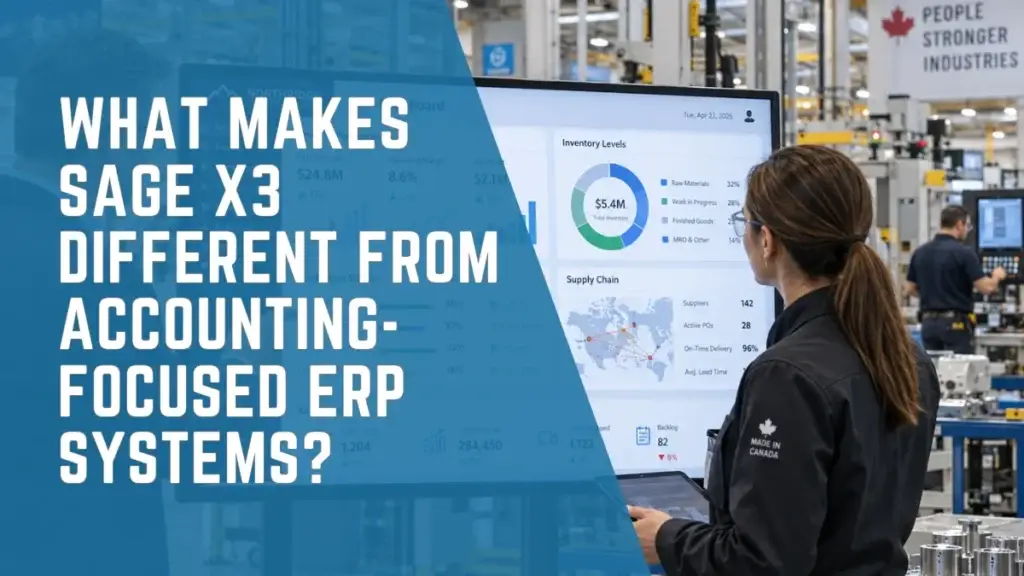
The ERP vs. accounting software comparison is an important consideration for businesses that need more than financial transaction management. While traditional accounting software handles bookkeeping and financial reporting, integrated ERP platforms such as Sage X3 connect finance with manufacturing, inventory, purchasing and supply chain operations.
As manufacturers and distributors grow, managing these activities through disconnected systems can create inefficiencies, inconsistent data and limited operational visibility. Sage X3 addresses these challenges by connecting financial management with the business processes that influence costs, production and profitability.
This article examines what makes Sage X3 different from accounting-focused ERP systems, compares their capabilities and explains when growing businesses may benefit from a more comprehensive ERP solution.
ERP vs Accounting Software: What Is the Difference?
The fundamental difference between ERP and accounting software is the scope of business processes each system manages.
Traditional accounting software primarily supports financial transactions, accounting records and financial reporting. Enterprise resource planning (ERP) software can extend these capabilities by connecting financial management with other business functions.
Depending on the solution, an ERP system may integrate purchasing, inventory, manufacturing, sales and supply chain management.
However, the distinction is not absolute. Some accounting platforms offer extensive operational functionality, while certain ERP systems concentrate primarily on financial management.
Businesses should therefore evaluate each product’s actual capabilities rather than rely exclusively on software categories.
Traditional Accounting Software
Traditional accounting software helps organizations record, manage and report financial information.
Its core capabilities typically include:
- General ledger management.
- Accounts payable and accounts receivable.
- Customer invoicing and payment tracking.
- Bank reconciliation and expense management.
- Basic budgeting and financial reporting.
- Tax-related reporting.
- Basic inventory tracking, depending on the product.
These capabilities may be sufficient for organizations with straightforward financial and operational requirements.
For example, a professional services company may primarily need invoicing, expense tracking, cash flow reporting and financial statements.
However, manufacturers and distributors often require additional functionality to manage materials, production, inventory and purchasing.
As operational complexity increases, businesses may find that traditional accounting software no longer addresses all their requirements.
Accounting-Focused ERP Systems
Accounting-focused ERP systems extend financial management beyond basic bookkeeping.
They may provide advanced financial reporting, multi-entity accounting, financial workflow automation, budgeting and other financial management capabilities.
Some systems also support purchasing, inventory, project management and additional business functions through built-in features, optional modules or third-party integrations.
These platforms can be appropriate for organizations whose most complex requirements involve financial management rather than physical production.
For example, a multi-entity professional services organization may prioritize financial consolidation, revenue management and project profitability.
A manufacturer, however, may require deeper functionality for production planning, material requirements, manufacturing costs and inventory traceability.
Integrated ERP Software
Integrated ERP software connects multiple business functions within a coordinated application environment.
Rather than managing financial and operational activities through separate applications, organizations can use integrated workflows to coordinate related processes.
For example, a manufacturing transaction can connect material consumption, inventory valuation, production costs and relevant financial records.
Similarly, a customer order can connect sales information with inventory availability, fulfilment and invoicing.
This integration can reduce duplicate data entry and support more consistent information across departments.
Sage X3 follows this broader approach by combining financial management with manufacturing, inventory and supply chain capabilities.
Sage X3 vs Accounting-Focused ERP Systems: Feature Comparison
Sage X3 combines financial management with operational capabilities designed for businesses managing manufacturing, inventory, purchasing and distribution.
Accounting-focused ERP systems, meanwhile, place greater emphasis on financial management. Their operational capabilities vary depending on the specific product, modules, configuration and integrations.
The following table illustrates the general differences between traditional accounting software, accounting-focused ERP systems and Sage X3.
Swipe left or right to view the full table →
| Business Capability | Traditional Accounting Software | Accounting-Focused ERP | Sage X3 ERP |
|---|---|---|---|
| General ledger | Core functionality | Advanced financial management | Integrated financial management |
| Accounts payable and receivable | Standard capabilities | Advanced capabilities and automation | Connected financial and operational processes |
| Financial reporting | Standard accounting reports | Advanced financial analytics | Financial and operational reporting |
| Multi-company accounting | Often limited or product-dependent | Frequently available | Multi-company and multi-site capabilities |
| Inventory management | Basic or optional | Depends on modules and integrations | Integrated inventory management |
| Manufacturing management | Usually limited | Product-dependent | Integrated production management |
| Bills of materials | Often requires additional software | May require extensions | Multi-level BOM capabilities |
| Production planning | Usually requires another application | Depends on the solution | Production planning and scheduling |
| Supply chain management | Limited or integration-dependent | Varies by product | Integrated purchasing, inventory and sales processes |
| Lot and batch traceability | Often requires specialized tools | Product-dependent | Integrated lot and batch management |
| Quality control | Generally requires another application | Varies by platform | Manufacturing and inventory quality controls |
| Multi-location operations | Often limited | Depends on the system | Multi-site operational management |
| Workflow automation | Primarily accounting workflows | Advanced financial workflows | Configurable cross-functional workflows |
| Operational visibility | Depends on connected applications | Varies by implementation | Connected financial, production and supply chain information |
Note: The comparison reflects general product positioning. Actual capabilities depend on the selected product, modules, configuration and implementation
The key distinction is how financial and operational capabilities work together.
For example, accounting software can record the cost of materials purchased by a manufacturer. Sage X3 can also connect purchasing information with inventory availability, production requirements and relevant financial records.
This integrated approach helps businesses evaluate operational activities alongside financial performance.
5 Key Capabilities That Set Sage X3 Apart
Sage X3 offers several integrated capabilities that may be particularly valuable to manufacturers, distributors and inventory-intensive businesses.
1. Integrated Financial Management and Operational Reporting
Financial management is a critical component of any ERP environment. However, organizations with complex operations need more than accurate accounting records. They also need to understand the activities influencing their financial results.
Sage X3 connects financial management with manufacturing, purchasing, inventory and other operational processes.
Its financial management capabilities include:
- General ledger and financial accounting.
- Accounts payable and accounts receivable.
- Cost accounting and budget management.
- Fixed asset management.
- Multi-company and multi-currency accounting.
- Financial reporting and analysis.
These capabilities connect with relevant operational transactions, allowing finance teams to investigate business performance using information from across the organization.
Connecting financial results with operational performance
For example, a manufacturer experiencing declining profitability can examine material costs, inventory movements and production-related expenses alongside its financial results.
Similarly, a distributor can use purchasing and inventory information to investigate changes in product profitability.
Sage X3’s integrated environment can support the analysis of financial and operational key performance indicators (KPIs), including gross profit margin, inventory turnover, production cost variances and working capital.
This broader visibility helps finance and operations teams make informed decisions.
However, the specific reporting capabilities and available KPIs depend on the system’s configuration, implemented functionality and underlying data quality.
2. Integrated Manufacturing Management
Manufacturing management is one of the most important distinctions in the ERP vs accounting software comparison.
Traditional accounting applications focus primarily on financial transactions. Although some accounting-focused ERP systems support manufacturing through additional modules or integrations, others require separate production applications.
Sage X3 includes manufacturing capabilities designed for discrete, process and mixed-mode production environments.
These capabilities help businesses coordinate materials, production activities, quality requirements and manufacturing costs.
Bills of materials management
A bill of materials (BOM) identifies the components and quantities required to manufacture a product.
Sage X3 supports multi-level BOMs, helping manufacturers manage complex product structures and establish material requirements.
For example, an industrial equipment manufacturer can use multi-level BOMs to organize assemblies and individual components needed for finished products.
Accurate BOM information supports purchasing, material planning, production and cost analysis.
Production planning and scheduling
Manufacturers must coordinate customer demand, material availability, production resources and delivery commitments.
Sage X3 provides production planning and scheduling capabilities that support the coordination of manufacturing activities.
Depending on the implementation, businesses can manage production orders, evaluate material requirements and coordinate relevant production processes.
For example, a manufacturer can review material availability before releasing a production order, helping teams identify potential shortages.
Manufacturing cost management
Manufacturing profitability depends on material consumption, labour, subcontracting, waste and production efficiency.
Sage X3 connects manufacturing activity with financial management, supporting production cost analysis and the investigation of cost variances.
For example, manufacturers can compare expected and actual production costs to identify potential inefficiencies and make more informed operational decisions.
Quality management and traceability
Quality control and product traceability are important requirements in many manufacturing environments.
Sage X3 provides quality and traceability capabilities that support manufacturing and inventory processes, including relevant lot and batch management functionality.
For example, a food manufacturer can use batch information to investigate the materials associated with a particular production run.
Similarly, a chemical manufacturer may use traceability information to support quality investigations and recall procedures.
However, businesses must still establish the controls, validation procedures and documentation required by applicable industry regulations.
3. Comprehensive Inventory Management
Basic accounting applications may track inventory quantities and values. However, manufacturers and distributors with complex warehouse operations often require additional inventory management capabilities.
Sage X3 provides integrated inventory management that connects stock information with purchasing, sales, manufacturing and financial processes.
Multi-site inventory management
Organizations operating multiple warehouses need reliable information about stock availability across locations.
Sage X3 supports inventory management across multiple sites, helping businesses establish consistent stock management processes.
For example, a distributor can evaluate inventory availability at different locations before making purchasing or replenishment decisions.
Lot and batch tracking
For businesses that manage products requiring traceability, lot and batch tracking can help maintain information about material origins and inventory movements.
Sage X3 supports lot and batch management within relevant inventory and production workflows.
This functionality is particularly relevant to food and beverage manufacturers, chemical producers and other organizations with detailed product traceability requirements.
Inventory replenishment
Maintaining appropriate inventory levels is both a financial and operational challenge.
Excess inventory increases storage costs and ties up working capital, while insufficient inventory can delay production and customer deliveries.
Sage X3 supports replenishment, purchasing and inventory transfer processes, helping organizations coordinate stock management with operational requirements.
Effective replenishment still depends on accurate inventory records, reliable demand assumptions and appropriate purchasing policies.
4. Connected Purchasing, Sales and Supply Chain Management
Purchasing, sales and supply chain activities influence profitability, customer service and operational continuity.
Traditional accounting applications generally focus on recording the financial consequences of these activities. Organizations may therefore require additional software to coordinate procurement, order processing and delivery requirements.
Sage X3 connects purchasing, sales and inventory management within a broader ERP environment.
Purchasing and procurement
Sage X3 provides purchasing capabilities that support supplier information, purchasing requests, quotations, purchase orders and relevant delivery processes.
Depending on the configuration, procurement teams can coordinate purchasing activities with inventory requirements and financial transactions.
Sales order management
Sales teams need reliable information about product availability, pricing and delivery commitments.
Sage X3 connects sales management with relevant inventory and supply chain processes.
For example, a distributor can review stock availability when processing a customer order, while warehouse and sales teams can coordinate order preparation, delivery and invoicing.
Supply chain coordination
Supplier delays, changing customer demand and material shortages can affect production schedules, fulfilment and profitability.
Sage X3 connects purchasing and sales processes with relevant inventory and manufacturing information.
This integration helps organizations coordinate procurement decisions, customer orders and delivery requirements.
For example, a manufacturer can evaluate material availability when planning production, while a distributor can review purchasing requirements when responding to customer demand.
5. Multi-Company and Multi-Site Operations
As businesses expand, their financial and operational requirements often become more complex.
A Canadian manufacturer may establish additional production facilities, open distribution centres or expand into the United States.
Similarly, a distributor may manage several warehouses or operate through multiple legal entities.
Sage X3 supports multi-company, multi-site and multi-currency operations.
Multi-company financial management
Organizations operating through multiple legal entities need appropriate accounting records and consistent financial oversight.
Sage X3 provides financial management capabilities across companies and currencies, helping finance teams establish coordinated processes.
However, organizations should validate their specific financial consolidation, statutory reporting and tax requirements during implementation.
Multi-site operational management
Sage X3 also supports operational processes across multiple business locations.
For example, a distributor can establish inventory transfer workflows between warehouses, while a manufacturer can coordinate relevant information across production facilities.
These capabilities can support expansion without requiring every location to maintain an entirely separate technology environment.
Sage X3 Can Reduce Dependence on Disconnected Applications
As organizations grow, they may rely on separate applications for accounting, inventory, purchasing and production.
Managing these systems can introduce duplicate data entry, reconciliation requirements and additional integration maintenance.
Sage X3 provides an integrated environment that can consolidate selected financial and operational processes, reducing reliance on manual data transfers and disconnected applications.
However, businesses may still require specialized solutions for e-commerce, warehouse automation or industry-specific functions.
Sage X3 supports integrations through its available APIs and integration capabilities.
The objective is to create a technology environment that supports the organization’s operational requirements rather than eliminate every external application.
ERP vs Accounting Software: Pricing and Total Cost of Ownership
Pricing is an important consideration when evaluating ERP vs accounting software.
Traditional accounting platforms may involve a lower initial investment when an organization requires only core financial functionality.
Broader ERP projects, however, often involve additional software capabilities, implementation services, integrations, data migration and employee training.
Sage X3 pricing depends on the organization’s requirements and commercial arrangement. Businesses should therefore request a tailored quotation rather than rely on a universal pricing estimate.
What Influences Sage X3 Implementation Costs?
Several factors can influence the total investment:
- Software licensing or subscription arrangements.
- Deployment model.
- Number and types of users.
- Required financial and operational capabilities.
- Number of companies and facilities.
- Manufacturing and inventory complexity.
- Data migration requirements.
- Third-party integrations.
- Workflow configuration and testing.
- Employee training.
- Ongoing support and maintenance.
For example, a single-site distributor may have different implementation requirements from a manufacturer operating several production facilities.
The project scope and budget should reflect the organization’s actual business processes and implementation needs.
ERP vs Accounting Software Cost Comparison
Swipe left or right to view the full table →
| Cost Consideration | Traditional Accounting Software | Accounting-Focused ERP | Sage X3 ERP |
|---|---|---|---|
| Initial software cost | Often lower for basic requirements | Depends on modules and users | Requirements-based quotation |
| Implementation | Often relatively straightforward | Depends on financial complexity | Depends on financial and operational scope |
| Manufacturing functionality | Often requires another application | May require modules or integrations | Integrated manufacturing capabilities |
| Inventory management | Basic or optional | Product-dependent | Integrated inventory management |
| Data migration | Primarily financial and selected operational data | Financial and relevant business data | Financial, inventory and operational data |
| Employee training | Primarily finance and administration | Finance and relevant departments | Finance, purchasing, manufacturing and operations |
| Integration requirements | May increase as the business expands | Depends on the application environment | Depends on retained applications and workflows |
| Ongoing support | Product-dependent | Depends on the solution and service agreement | Depends on deployment and support arrangements |
How CFOs Should Evaluate ERP Return on Investment
A meaningful ERP business case should consider both implementation costs and potential operational benefits.
For manufacturers and distributors, these benefits may include reduced manual reconciliation, improved inventory accuracy, more efficient purchasing processes and better production cost visibility.
However, projected benefits should be based on current performance, documented requirements and realistic implementation assumptions.
A structured ERP assessment can help organizations evaluate the total cost of ownership and establish measurable expectations before committing to an implementation.
Which Industries Can Benefit from Sage X3?
Sage X3 is particularly relevant to businesses that manufacture, purchase, store or distribute physical products.
However, ERP selection should reflect the organization’s operational complexity, reporting requirements and existing technology rather than industry alone.
Manufacturing
Manufacturers need to coordinate production planning, purchasing, material requirements, inventory and manufacturing costs.
Sage X3 supports these activities through integrated manufacturing and financial management.
For example, an industrial manufacturer can use production and material information to investigate manufacturing costs, while multi-site capabilities can support organizations operating several facilities.
Food and Beverage
Food and beverage manufacturers often manage batch production, expiration dates, product quality and traceability.
Sage X3 provides process manufacturing, batch management and traceability capabilities relevant to these requirements.
These features can support production control, inventory management and quality investigations.
Wholesale Distribution
Distributors must coordinate purchasing, inventory availability, customer orders and warehouse operations.
Sage X3 connects inventory, sales, purchasing and financial information, supporting more consistent workflows across these activities.
Its multi-site capabilities may also benefit distributors operating several warehouses or distribution centres.
Chemical and Process Manufacturing
Chemical manufacturers may need to manage formulations, production batches, material traceability and quality requirements.
Sage X3 provides process manufacturing capabilities that can help coordinate these activities with inventory and financial management.
Businesses should validate any applicable regulatory and industry-specific requirements during solution selection.
Inventory-Intensive Businesses
Organizations that do not manufacture products may still have complex inventory requirements.
For example, importers and multi-location distributors may need detailed stock management, purchasing coordination and supply chain visibility.
Sage X3’s integrated inventory and purchasing capabilities can support these operational requirements.
When Should a Growing Business Consider Sage X3?
Moving from accounting software to a broader ERP solution should address identifiable business challenges.
For many organizations, existing accounting software remains appropriate. However, the following conditions may indicate a need to evaluate Sage X3 or another integrated ERP platform.
1. Manufacturing Relies on Spreadsheets
Production teams may use separate spreadsheets to manage bills of materials, scheduling and material requirements.
As production becomes more complex, coordinating these activities across departments can become difficult.
2. Inventory Information Is Inconsistent
Warehouse, purchasing and finance teams may maintain different inventory records.
These inconsistencies can increase reconciliation requirements and make stock management decisions less reliable.
3. Financial Reporting Requires Extensive Manual Work
Finance teams may spend significant time combining information from accounting, inventory and production applications.
An integrated ERP environment can reduce some of these dependencies and support more coordinated reporting.
4. The Business Operates Across Multiple Locations
Additional warehouses, production facilities and legal entities can introduce more complex financial and operational requirements.
Organizations may benefit from evaluating systems that support multi-site and multi-company management.
5. Manufacturing Costs Are Difficult to Analyze
Finance leaders may struggle to connect material consumption and production activity with financial results.
Integrated manufacturing and financial information can support more detailed production cost analysis.
6. Existing Technology Limits Expansion
New products, facilities, business models or transaction volumes may require capabilities that the current software environment cannot support effectively.
In these situations, businesses should assess whether their existing systems can be optimized or whether a broader ERP solution is necessary.
Is Sage X3 the Right ERP for Every Business?
Sage X3 is designed for organizations that need substantial financial and operational functionality. However, not every business requires the same level of manufacturing or supply chain management.
For example, a professional services organization with complex financial reporting requirements but limited inventory may benefit from a financial management-focused platform.
Similarly, a distributor with straightforward operational requirements may find that another ERP configuration is sufficient.
IWI Consulting Group specializes in Sage Intacct, Sage 300 and Sage X3, which support different combinations of business requirements.
| Solution | Primary Positioning | Typical Requirements |
|---|---|---|
Sage Intacct | Cloud financial management | Multi-entity accounting, financial automation, reporting and financial visibility |
Sage 300 | Financial and operational business management | Distribution, inventory-intensive operations and multi-location management |
Sage X3 | Integrated financial, manufacturing and supply chain management | Complex manufacturing, production, inventory and multi-site operations |
The table reflects general product positioning rather than every available feature.
For example, Sage 300 can support manufacturing requirements through appropriate modules and connected solutions. Similarly, Sage Intacct can integrate with specialized operational applications.
The right ERP solution depends on the organization’s business processes, financial requirements, existing technology and long-term strategy.
Planning a Migration from Accounting Software to Sage X3
Moving from accounting software to Sage X3 requires more than transferring financial records.
Because Sage X3 connects financial management with operational processes, implementation may affect finance, purchasing, manufacturing, inventory and other departments.
A structured migration typically involves:
- Assessing existing systems: Identify current business processes, disconnected applications and operational challenges.
- Defining business requirements: Establish the financial, manufacturing, inventory and reporting capabilities needed in the new environment.
- Preparing data: Cleanse and validate financial records, customer and supplier information, inventory data, bills of materials and other relevant records.
- Configuring and integrating Sage X3: Configure the platform around approved business processes and connect any applications that remain necessary.
- Testing business workflows: Validate end-to-end processes, including relevant purchasing, production, inventory and financial transactions.
- Training employees: Prepare teams for the new system and establish appropriate transition and post-implementation support procedures.
The complexity of the project depends on the organization’s existing technology, operational requirements, data quality and integration needs.
Working with an experienced ERP implementation partner can help organizations establish a structured migration strategy while managing potential business disruption.
How IWI Consulting Group Supports Sage X3 Implementation
Selecting the right ERP platform requires a consulting partner that understands your financial requirements, operational processes and long-term business goals.
With more than 25 years of experience and over 500 successful projects delivered, IWI Consulting Group helps businesses across Canada and the United States evaluate, implement, migrate and optimize Sage solutions.
Its services include ERP assessment and strategic advisory, Sage X3 implementation, data migration, system integration, employee training and ongoing support. With experience in migrations from QuickBooks, Sage 50, Sage BusinessVision and Microsoft Dynamics GP, IWI helps organizations transition to ERP solutions that align with their business requirements.
Through its implementation expertise and ongoing support, IWI helps businesses improve operational efficiency and establish an ERP environment that supports long-term growth.
What is the main difference between ERP and accounting software?
What is the main difference between ERP and accounting software?
Accounting software primarily manages financial transactions, accounting records and financial reporting. ERP systems can extend these capabilities by connecting financial management with purchasing, inventory, manufacturing, sales and other business processes.
Sage X3 combines financial management with broader operational functionality within an integrated ERP environment.
Is Sage X3 more expensive than traditional accounting software?
Sage X3 generally involves a broader implementation scope than basic accounting software when an organization requires manufacturing, inventory and supply chain functionality.
Actual pricing depends on licensing, deployment, user requirements, implementation complexity and integrations. Businesses should compare total cost of ownership against the functionality and operational benefits they need.
Can Sage X3 replace accounting software for a growing business?
Yes. Sage X3 includes financial management alongside manufacturing, inventory, purchasing and supply chain capabilities.It can replace an existing accounting application when the organization needs a broader ERP environment. However, the decision should follow an assessment of business requirements, existing systems and migration needs.
Can manufacturers migrate from accounting software to Sage X3?
Yes. Manufacturers can transition from accounting software to Sage X3 through a structured ERP implementation project.
Depending on the existing systems and project scope, migration may include financial records, customer and supplier information, inventory, bills of materials and production data.
Does Sage X3 integrate with other business applications?
Yes. Sage X3 provides APIs and integration capabilities that support connections with other applications.Depending on the organization’s requirements, these may include e-commerce platforms, customer management systems, specialized warehouse applications and other business software. Each integration should be evaluated for compatibility, security and ongoing maintenance.
Which industries can benefit from Sage X3?
Sage X3 is particularly relevant to manufacturing, food and beverage, chemical production, wholesale distribution and inventory-intensive businesses.
These organizations may benefit from integrated financial management, production planning, inventory management, traceability and supply chain coordination. However, businesses should evaluate the platform against their specific operational, financial and industry requirements.
Conclusion: Understanding What Sets Sage X3 Apart
The key difference between Sage X3 and accounting-focused ERP systems lies in the breadth of operational capabilities and how financial management connects with manufacturing, inventory and supply chain processes.
For manufacturers, distributors and inventory-intensive businesses, these capabilities can support more coordinated operations, better cost analysis and greater visibility across departments.
However, the right ERP solution depends on each organization’s business requirements, existing technology and long-term objectives.
IWI Consulting Group helps businesses evaluate Sage solutions and develop ERP strategies aligned with their financial and operational requirements.
Ready to explore whether Sage X3 is right for your business?
Contact IWI Consulting Group to discuss your ERP requirements, implementation options and migration strategy.