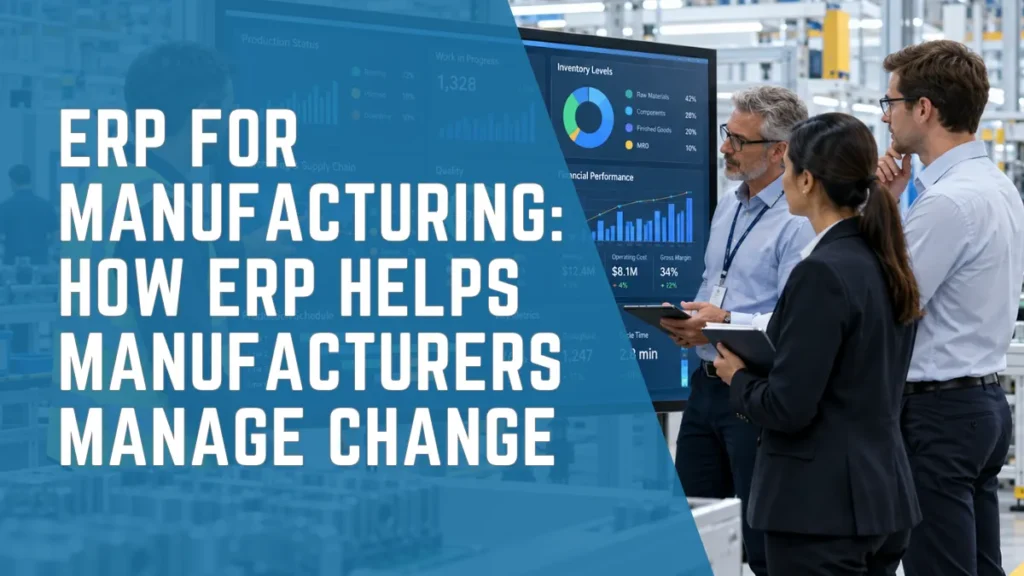
Manufacturers face constant pressure to control costs, improve production efficiency, manage inventory, respond to supply chain disruption, and meet changing customer demand. ERP for manufacturing helps bring those moving parts together by connecting finance, production, inventory, purchasing, supply chain, and reporting within one integrated business system.
For CFOs and operations leaders, that visibility has become increasingly important. When production schedules, material availability, costs, and financial data sit in separate systems, teams often spend more time reconciling information than acting on it. As a result, decision-making slows, and operational problems can become more expensive.
Modern manufacturing ERP systems give organizations a more complete view of what is happening across the business. They can help manufacturers identify production issues earlier, improve inventory control, understand changes in costs and margins, and coordinate decisions across departments.
However, the real value of manufacturing ERP software goes beyond automation. A well-designed ERP environment creates a stronger foundation for managing change, supporting growth, and improving both operational and financial performance.
This article explains how ERP helps manufacturers manage change, which capabilities matter most, how Sage X3 and Sage 300 fit different manufacturing environments, and what organizations should consider before selecting or replacing an ERP system.
Why Managing Change Is So Difficult for Manufacturers
Manufacturing businesses operate across many interconnected processes. A change in one area can quickly affect several others.
For example, a delayed shipment of raw materials may change the production schedule. Consequently, that schedule change can affect labor requirements, customer delivery dates, inventory availability, cash flow, and projected margins.
Similarly, a sudden increase in customer demand can create pressure throughout the organization. Purchasing may need more materials. Production may need additional capacity. Warehousing may require more space. Finance may need to evaluate working capital requirements.
Without integrated information, each department can respond to a different version of the situation.
That creates several common challenges:
- Production plans become disconnected from actual demand.
- Inventory levels do not match operational requirements.
- Finance receives cost information too late.
- Purchasing lacks visibility into upcoming production needs.
- Customer service cannot confidently communicate delivery dates.
- Management reporting depends heavily on spreadsheets.
- Employees spend time reconciling information between systems.
- Decisions become reactive rather than proactive.
The problem becomes more serious as the manufacturer grows.
Adding products, warehouses, plants, legal entities, suppliers, currencies, or distribution channels increases operational complexity. Therefore, processes that worked when the company was smaller may become increasingly difficult to manage.
ERP for manufacturing creates a common operating environment where financial and operational information can move together.
That connection is critical because manufacturing performance cannot be managed effectively through accounting information alone.
What Is ERP for Manufacturing?
ERP for manufacturing is an enterprise resource planning platform designed to connect the financial, production, inventory, purchasing, supply chain, sales, and operational processes required to run a manufacturing organization.
Unlike basic accounting software, a manufacturing ERP system can support business processes that begin long before an invoice reaches the general ledger.
For example, an ERP system for manufacturers may connect:
- Customer demand
- Sales orders
- Bills of materials
- Material requirements
- Purchasing
- Inventory
- Production planning
- Work orders
- Shop floor activity
- Quality control
- Warehousing
- Shipping
- Cost accounting
- Financial reporting
As a result, finance and operations can work from the same underlying business information.
This integration matters because operational events eventually create financial outcomes.
Material consumption affects product costs. Production efficiency affects margins. Scrap affects profitability. Inventory levels affect working capital. Purchasing decisions affect cash flow.
Therefore, manufacturers gain more value when ERP connects these relationships instead of treating production and finance as separate processes.
Modern platforms such as Sage X3 are specifically designed to bring production, supply chain, and financial information together. Sage currently positions Sage X3 around capabilities including production management, BOM planning, shop floor control, quality control, inventory management, purchasing, financial management, and multi-company operations.
Why Manufacturers Outgrow Disconnected Systems
Many manufacturing organizations do not immediately recognize that they have outgrown their existing systems.
Instead, employees create workarounds.
A spreadsheet may become the production schedule. Another workbook may track inventory availability. Purchasing may maintain separate supplier information. Meanwhile, finance may export information from several applications before preparing management reports.
Initially, these workarounds can appear practical. However, they become difficult to maintain as transaction volumes and operational complexity increase.
Several warning signs often indicate that the existing technology environment is becoming a constraint.
Reporting Requires Extensive Manual Work
When monthly reporting requires information from several applications, employees spend significant time gathering and reconciling data.
Consequently, finance may spend more time building reports than analyzing performance.
Management also receives information later. Therefore, problems can continue for days or weeks before leadership sees their financial impact.
Inventory Accuracy Is Difficult to Maintain
Inventory is one of the largest working capital investments for many manufacturers.
However, inaccurate inventory information can lead to overstocking, shortages, emergency purchasing, production interruptions, and poor customer service.
A manufacturing ERP system helps connect inventory movements to purchasing, production, sales, and warehouse activity.
As a result, inventory decisions can be based on more timely operational information.
Production Planning Depends on Spreadsheets
Spreadsheets are useful tools. Nevertheless, they become difficult to manage when production plans involve many products, resources, materials, customer requirements, and locations.
A schedule can change shortly after it is created.
Therefore, planners need systems that can connect schedules with demand, inventory availability, material requirements, work orders, and capacity.
Finance and Operations Use Different Information
This challenge is particularly important.
Operations may measure production units, yield, downtime, scrap, and throughput. Meanwhile, finance may focus on costs, margins, working capital, and profitability.
Both perspectives matter.
However, when the underlying data is disconnected, executives may struggle to understand the financial implications of operational performance.
ERP for manufacturing helps bridge that gap.
How ERP for Manufacturing Improves Visibility
Manufacturing companies generate enormous amounts of operational information.
The challenge is not simply collecting data. Instead, organizations need to make relevant information available to the people who can act on it.
Modern manufacturing ERP software can provide visibility across several critical areas.
Swipe left or right to view the full table →
| Area | Visibility ERP Can Provide | Business Impact |
|---|---|---|
| Production | Work orders, production status, schedules, work in progress | Faster response to production issues |
| Inventory | Raw materials, WIP, finished goods, lot or serial information | Better inventory control |
| Purchasing | Supplier orders, expected receipts, material requirements | Improved purchasing decisions |
| Finance | Costs, margins, budgets, cash requirements | Stronger financial control |
| Sales | Customer orders and demand | Better coordination with production |
| Quality | Inspections, quality events, traceability | Improved quality management |
| Supply chain | Materials and product movement | Better disruption response |
| Executive reporting | Cross-functional KPIs | Faster decision-making |
For example, Sage X3 currently provides capabilities for monitoring production KPIs and work in progress while connecting production data with finance and supply chain processes. It also supports BOM management, traceability, quality control, and multi-site manufacturing scenarios.
The strategic value comes from connecting these areas.
A production delay is not only an operations issue. It may affect sales commitments, inventory availability, labor utilization, revenue forecasts, and cash flow.
Therefore, leadership gains more useful insight when ERP shows the relationships between operational events and business outcomes.
ERP Helps Manufacturers Respond Faster to Demand Changes
Demand rarely remains predictable.
Manufacturers may experience seasonal patterns, unexpected orders, customer cancellations, new product launches, changing market conditions, or shifts between product categories.
Consequently, production plans must change.
However, responding effectively requires more than adjusting a schedule.
The manufacturer must understand several questions:
- Are the required materials available?
- Can suppliers meet additional demand?
- Is sufficient production capacity available?
- Will another customer order be delayed?
- What will the change do to inventory levels?
- How will overtime affect production costs?
- What will happen to margins?
- Can the organization meet the requested delivery date?
When production, purchasing, inventory, sales, and finance operate independently, answering these questions can require several conversations and spreadsheets.
In contrast, manufacturing ERP systems provide a connected information foundation.
Production teams can evaluate demand alongside material and operational requirements. Purchasing can see requirements earlier. Finance can understand the potential cost implications.
As a result, the manufacturer becomes more responsive without relying entirely on manual coordination.
Better Inventory Management Creates Financial Benefits
Inventory management is both an operational and financial discipline.
Too little inventory can interrupt production and reduce customer service. However, excessive inventory consumes cash, occupies warehouse space, increases carrying costs, and can create obsolescence risk.
Therefore, effective manufacturers must balance availability with working capital efficiency.
ERP for manufacturing helps create that balance by connecting inventory with demand, purchasing, production, and sales.
For example, manufacturers can gain better visibility into:
- Raw material requirements
- Inventory on hand
- Inventory by location
- Work in progress
- Finished goods
- Expected receipts
- Customer demand
- Production consumption
- Lot and serial information
- Inventory movements
Furthermore, stronger inventory visibility helps finance leaders understand why working capital changes.
Instead of seeing only an inventory value on the balance sheet, management can gain greater insight into the operational activity behind that number.
This matters because inventory problems often signal broader issues.
Excess raw materials may indicate inaccurate forecasting. Growing work in progress may indicate production bottlenecks. Finished goods accumulation may indicate slowing demand.
Therefore, integrated ERP data can support both operational action and financial analysis.
ERP for Manufacturing Connects Production and Financial Performance
One of the most important benefits of manufacturing ERP is the connection between production activity and financial outcomes.
Traditional accounting systems are primarily designed to record financial transactions.
Manufacturing, however, introduces additional complexity.
Organizations need to understand the cost of converting materials into finished products. Depending on the manufacturing model, that may include:
- Raw materials
- Labor
- Machine time
- Overhead
- Subcontracting
- Scrap
- Yield
- Rework
- Freight
- Packaging
- Other production-related costs
When this information exists across several systems, determining accurate product costs can become difficult.
Consequently, finance leaders may struggle to analyze profitability by product, customer, location, or production line.
ERP creates an opportunity to connect operational activity more closely with financial reporting.
Therefore, executives can move beyond asking, “What was the total cost?” and begin asking more valuable questions.
- Why did the cost change?
- Which operational factors caused the variance?
- Which products or customers generate stronger margins?
- Where is waste affecting profitability?
- Which production areas require management attention?
That level of visibility supports stronger decision-making.
Production Planning Becomes More Connected
Production planning is one of the areas where disconnected systems create significant operational risk.
Manufacturers must coordinate materials, labor, equipment, customer requirements, inventory, and capacity.
Meanwhile, conditions constantly change.
A supplier may deliver late. A machine may require maintenance. A large customer may change an order. A quality issue may place materials on hold.
Therefore, production planning cannot remain isolated.
A modern manufacturing ERP system can connect planning with the broader business environment.
Depending on system configuration and manufacturing requirements, capabilities may include:
- Bills of materials
- Routings
- Production schedules
- Work orders
- Material requirements
- Demand information
- Capacity considerations
- Production tracking
- Shop floor information
- Quality processes
- Production costing
Sage X3, for example, includes manufacturing functionality across BOM management, production planning, work orders, scheduling, shop floor control, project management, and quality processes. Sage also highlights demand-driven planning and consolidated production visibility across multiple sites.
As a result, planners can make decisions using more connected operational information.
Manufacturing ERP Supports Quality and Traceability
For many manufacturers, quality cannot be managed as an isolated process.
A quality issue may affect production schedules, available inventory, supplier relationships, customer shipments, compliance requirements, and financial performance.
Therefore, quality information should connect with the broader ERP environment.
This is especially important in industries such as:
- Food and beverage
- Chemicals
- Process manufacturing
- Industrial products
- Regulated manufacturing
- Batch-oriented manufacturing
- Traceability can become equally important.
Organizations may need to understand where raw materials originated, how they were used, which batches or lots were affected, and where finished products were shipped.
For food and beverage organizations, for example, Sage X3 currently emphasizes lot tracking, quality control, recipe management, compliance, and recall-related traceability.
The business value extends beyond compliance.
Better quality visibility can help reduce waste, identify recurring problems, protect customer relationships, and improve operational consistency.
Collaboration Improves When Teams Share the Same Data
Manufacturing performance depends on collaboration.
Production cannot operate independently from purchasing. Purchasing cannot operate independently from inventory. Inventory affects finance. Sales affects production. Production affects customer commitments.
However, collaboration becomes difficult when each department works from different information.
ERP for manufacturing creates a shared data environment.
Therefore, conversations can focus less on determining which spreadsheet is correct and more on deciding what action should be taken.
For example, a shortage identified by production can become visible to purchasing. The potential schedule impact can become visible to customer-facing teams. Meanwhile, finance can understand the potential impact on cost or revenue timing.
As a result, decision cycles can become shorter.
This does not mean ERP eliminates the need for communication.
Instead, it gives employees a stronger factual foundation for that communication.
Real-Time Reporting Helps Manufacturers Manage Change
Traditional management reporting often explains what happened last month.
That remains important.
However, manufacturers also need information that helps them understand what is happening now.
For example, management may need visibility into:
- Production output
- Material availability
- Work in progress
- Order status
- Inventory levels
- Purchasing commitments
- Quality issues
- Production costs
- Gross margins
- Working capital
- Operational KPIs
When information arrives too late, management has fewer opportunities to influence the outcome.
Therefore, modern ERP reporting should support both historical financial reporting and current operational visibility.
Sage X3 currently positions real-time production visibility as a core manufacturing capability, including monitoring KPIs and work in progress while connecting production with financial and supply chain information.
For CFOs and controllers, this connection is especially valuable.
Finance becomes better equipped to explain why performance is changing rather than simply reporting the final numbers.
ERP Can Support Manufacturing Growth and Scalability
Growth creates opportunities. However, growth also creates complexity.
A manufacturer may add:
- New products
- New customers
- New plants
- Additional warehouses
- Legal entities
- International operations
- New suppliers
- Distribution channels
- Acquired companies
- More transactions
Each change creates new information requirements.
Systems that performed adequately at a smaller scale may eventually become barriers.
For example, spreadsheet-based consolidation may become unmanageable after several entities are added. Inventory processes may become inconsistent across warehouses. Reporting may require increasingly large amounts of manual work.
Therefore, scalability should be considered during ERP selection.
The right platform should support not only current operations but also realistic future complexity.
Sage X3 is positioned by Sage for growing product-centric organizations with manufacturing, distribution, multi-site, multi-company, multi-currency, and complex supply chain requirements.
IWI Consulting Group similarly positions Sage X3 for manufacturing, food and beverage, distribution, multi-site businesses, complex supply chains, and process manufacturing.
Sage X3 vs. Sage 300 for Manufacturing
Manufacturing organizations do not all require the same ERP platform.
Operational complexity, production requirements, inventory needs, reporting requirements, company size, integration requirements, and future growth plans should influence ERP selection.
For IWI Consulting Group, Sage X3 and Sage 300 can serve different manufacturing profiles.
Swipe left or right to view the full table →
| Consideration | Sage X3 | Sage 300 |
|---|---|---|
| Manufacturing complexity | Strong fit for more complex manufacturing | Better suited to less complex operational environments, often with extensions |
| Process manufacturing | Strong fit | May require additional solutions |
| Production management | Broad integrated capabilities | More dependent on configuration and add-ons |
| Inventory | Advanced operational integration | Strong inventory management foundation |
| Multi-site operations | Designed for complex multi-site scenarios | Appropriate for many established mid-market environments |
| Quality and traceability | Strong manufacturing-oriented capabilities | Requirements should be evaluated carefully |
| Supply chain complexity | Strong fit | Suitable where requirements are more moderate |
| Financial management | Integrated with operations | Strong financial and operational control |
| Best general fit | Complex manufacturers, food and beverage, process manufacturing, multi-site operations | Established, inventory-intensive or existing Sage environments with moderate manufacturing requirements |
Sage 300 provides inventory control, perpetual inventory records, serialized inventory, and lot tracking. Furthermore, its ecosystem includes manufacturing and distribution extensions that can expand operational capabilities.
Sage X3, in contrast, provides deeper production functionality directly across manufacturing, supply chain, and finance.
Therefore, ERP selection should not begin with a predetermined software preference.
It should begin with requirements.
IWI Consulting Group takes this approach by evaluating operational complexity, financial requirements, growth strategy, data, integrations, and future-state requirements before recommending a platform.
What Capabilities Should Manufacturing ERP Software Include?
No single checklist applies to every manufacturer.
However, several capabilities deserve evaluation when organizations compare manufacturing ERP systems.
1. Financial Management
Manufacturers need strong accounting and financial controls.
However, the ERP should also connect financial results to operational drivers.
Relevant requirements may include:
- General ledger
- Accounts payable
- Accounts receivable
- Cash management
- Budgeting
- Fixed assets
- Multi-company accounting
- Multi-currency capabilities
- Cost analysis
- Financial reporting
2. Inventory Management
Inventory capabilities should reflect actual manufacturing requirements.
Therefore, organizations may need to consider:
- Multiple warehouses
- Location tracking
- Lot control
- Serial tracking
- Expiration dates
- Raw materials
- Work in progress
- Finished goods
- Inventory transfers
- Cycle counting
3. Production Management
Depending on manufacturing complexity, relevant functionality may include:
- Bills of materials
- Routings
- Work orders
- Production planning
- Scheduling
- Material requirements
- Shop floor control
- Production tracking
- Subcontracting
- Capacity management
4. Quality Management
Manufacturers with quality-sensitive or regulated operations should evaluate:
- Inspections
- Quality testing
- Holds
- Traceability
- Nonconformance processes
- Quality documentation
- Recall support
5. Supply Chain Management
ERP should support coordination beyond the factory.
For example, manufacturers may need better visibility into purchasing, suppliers, inbound materials, inventory, warehousing, orders, and customer demand.
6. Reporting and Analytics
Reporting should give different decision-makers relevant information.
Operations managers may need production performance. Finance may need margin analysis. Executives may need consolidated KPIs.
Therefore, reporting requirements should be defined by role and decision rather than by simply creating more reports.
Why ERP Implementation Strategy Matters
Selecting manufacturing ERP software is only one part of the transformation.
Implementation quality can have an equally important impact on results.
Manufacturing organizations often have highly specific workflows, historical processes, integrations, data structures, and reporting requirements.
Therefore, ERP implementation should begin with business analysis.
A structured implementation may include:
- Business process assessment
- Requirements definition
- Future-state process design
- Solution configuration
- Data migration planning
- Integration design
- Reporting design
- Testing
- User training
- Go-live preparation
- Post-go-live support
- Ongoing optimization
Data deserves particular attention.
Poor item records, duplicate suppliers, inconsistent units of measure, inaccurate bills of materials, or weak inventory data can create problems after migration.
Therefore, organizations should treat data preparation as a business workstream rather than simply an IT task.
Testing is equally important.
Users should test realistic end-to-end scenarios, including purchasing, receiving, production, inventory, sales, shipping, costing, and financial reporting.
As a result, issues can be identified before the new environment becomes operational.
ERP Integration Should Be Planned Around Business Processes
Manufacturing ERP rarely operates alone.
Organizations may use systems for:
- E-commerce
- Customer relationship management
- Warehouse management
- Electronic data interchange
- Shipping
- Business intelligence
- Payroll
- Maintenance
- Manufacturing execution
- CAD or engineering
- Banking
- Supplier platforms
- Customer portals
Therefore, integration planning should begin early.
The key question is not simply whether two applications can connect.
Instead, the organization should determine which system owns each type of data, when information must move, what validations are required, and what happens when an integration fails.
For example, engineering information may originate in another platform but ultimately affect bills of materials in ERP.
Similarly, warehouse transactions may originate through scanners but must correctly update inventory and financial records.
Strong integration design therefore protects data quality and business continuity.
How ERP Helps CFOs and Operations Leaders Work Together
Manufacturing transformation requires cooperation between finance and operations.
Each group brings a different perspective.
Operations leaders often focus on:
- Throughput
- Capacity
- Yield
- Quality
- Scheduling
- Material availability
- On-time delivery
- Downtime
Finance leaders often focus on:
- Revenue
- Margin
- Cost
- Working capital
- Cash flow
- Variances
- Forecasts
- Financial controls
ERP can connect these perspectives.
For example, a CFO may see margin erosion. Meanwhile, ERP information may help reveal whether that erosion relates to material cost increases, lower yields, overtime, scrap, or production inefficiency.
Similarly, an operations manager may want to increase inventory to prevent shortages. Finance can evaluate the working capital implications.
Therefore, shared information creates better discussions.
Rather than treating financial and operational metrics separately, leadership can evaluate how operational choices affect financial performance.
ERP for Manufacturing Should Support Continuous Improvement
ERP implementation should not be viewed as the final step in business improvement.
Instead, go-live establishes a new operating foundation.
After implementation, organizations may identify additional opportunities to improve:
- Reporting
- Dashboards
- Automation
- Workflows
- Integrations
- Inventory practices
- Production processes
- User adoption
- Financial controls
- Master data
- Management KPIs
As the business changes, the ERP environment should evolve as well.
For example, a manufacturer may acquire another company, open a facility, launch a new product category, implement a warehouse system, or change its supply chain model.
Consequently, ERP configuration and processes may need adjustment.
A long-term ERP partner can help organizations evaluate these changes and determine how technology should support them.
How IWI Consulting Group Supports Manufacturing ERP Transformation
IWI Consulting Group works with organizations across Canada and the United States to evaluate, implement, migrate, integrate, optimize, and support ERP environments.
With more than 25 years of ERP experience and more than 500 organizations supported, IWI combines finance, operations, and technology expertise rather than approaching ERP as a software installation alone.
For manufacturers, that distinction matters.
Successful manufacturing ERP projects require an understanding of how financial requirements connect with production, inventory, supply chain, reporting, data, and operational workflows.
IWI’s services can support the full ERP lifecycle, including:
- ERP assessment and strategy
- Solution selection
- Business process analysis
- Sage X3 implementation
- Sage 300 implementation
- ERP migration
- Data migration
- System integration
- Financial and operational reporting
- User training
- Go-live support
- Ongoing ERP support
- ERP optimization
IWI positions Sage X3 for manufacturing and complex operations, including food and beverage, multi-site organizations, process manufacturing, and complex supply chains. Meanwhile, Sage 300 can remain a strong option for established organizations where inventory, financial control, operational continuity, and existing Sage investments are important.
Most importantly, ERP recommendations should reflect the organization’s actual requirements.
A manufacturer should not select a platform simply because it has the longest feature list.
Instead, leadership should evaluate operational complexity, industry requirements, reporting needs, growth plans, integration requirements, internal resources, and the desired future operating model.
That consultative approach helps turn ERP from a technology project into a business improvement initiative.
The Business Case for Modern Manufacturing ERP
The business case for ERP varies by manufacturer.
Some organizations need to replace outdated software. Others need stronger inventory controls. Meanwhile, rapidly growing companies may need systems capable of supporting multiple sites or entities.
However, several potential business outcomes appear repeatedly.
Manufacturers may seek to:
- Improve visibility across operations
- Reduce spreadsheet dependency
- Improve inventory accuracy
- Strengthen production planning
- Connect finance and operations
- Improve product costing
- Improve traceability
- Reduce manual data entry
- Standardize processes
- Improve reporting
- Support multiple locations
- Improve scalability
- Create stronger financial controls
- Respond faster to operational change
Therefore, ERP evaluation should focus on measurable business problems.
For example, “improve reporting” is too broad.
A stronger objective might be to reduce the time required to prepare weekly production and financial reports or eliminate manual reconciliation between production and accounting systems.
Similarly, “improve inventory” can become a set of more specific goals involving inventory accuracy, stock availability, working capital, or warehouse productivity.
Clear objectives make ERP selection and implementation more effective.
ERP for Manufacturing Creates a Stronger Foundation for Change
Manufacturers cannot eliminate change.
Demand will fluctuate. Supply chains will evolve. Costs will move. Customer expectations will increase. New regulations may appear. Products will change. Businesses will grow.
Therefore, the competitive question is not whether change will happen.
It is how effectively the organization can respond.
ERP for manufacturing gives finance and operations leaders a more connected foundation for managing that response.
By bringing production, inventory, purchasing, supply chain, financial management, quality, and reporting into a more integrated environment, manufacturers can gain better visibility into what is happening across the organization.
As a result, teams can identify issues sooner, understand their implications, and coordinate decisions more effectively.
However, technology alone does not create these outcomes.
The ERP must fit the business. Data must be reliable. Processes must be designed carefully. Users must understand the system. Integrations must work correctly. Finally, the ERP environment should continue to evolve as business requirements change.
For manufacturers evaluating Sage X3, Sage 300, or a broader ERP modernization strategy, IWI Consulting Group provides the combination of ERP consulting, implementation expertise, migration experience, and long-term support required to connect technology decisions with business outcomes.
A structured ERP assessment can help determine whether the current environment can support the organization’s next stage of growth or whether a modern manufacturing ERP platform would provide a stronger foundation.
Frequently Asked Questions About ERP for Manufacturing
How Much Does ERP for Manufacturing Cost?
Manufacturing ERP pricing varies based on the selected platform, number of users, modules, implementation scope, integrations, data migration requirements, reporting needs, and operational complexity.
Manufacturers should evaluate total implementation and ownership costs rather than comparing software subscription or licensing prices alone.
A requirements assessment provides a more reliable basis for estimating the overall investment.
Can a Manufacturing ERP System Scale as a Company Grows?
Yes, although scalability depends on the ERP platform and implementation design.
Manufacturers expecting additional locations, companies, products, transactions, currencies, or production complexity should evaluate those future requirements during ERP selection.
Sage X3, for example, is designed for complex, product-centric, and multi-site organizations, while Sage 300 can suit established mid-market environments with more moderate operational requirements.
What Should Manufacturers Consider When Migrating to a New ERP?
Manufacturers should evaluate data quality, item masters, suppliers, customers, inventory, bills of materials, historical transactions, reporting requirements, integrations, testing, training, and cutover planning.
The migration strategy should also distinguish between data that must move to the new ERP and historical information that can remain archived.
A structured migration strategy can reduce risk and support stronger user adoption.
How Long Does Manufacturing ERP Implementation Take, and What Does Implementation Involve?
Implementation timelines depend on operational complexity, the number of locations, integrations, data quality, custom requirements, internal resources, and the selected ERP system.
A typical implementation may include discovery, requirements analysis, configuration, data migration, integration development, reporting, testing, training, cutover, and post-go-live support.
Complex multi-site or process manufacturing projects generally require more planning than simpler financial and inventory implementations.
Can Manufacturing ERP Integrate With Warehouse, E-Commerce, Reporting, Engineering, or Other Business Systems?
Modern ERP platforms can integrate with many external applications, although integration requirements should be evaluated during solution design.
Manufacturers commonly connect ERP with warehouse management, EDI, shipping, e-commerce, CRM, business intelligence, payroll, maintenance, MES, CAD, engineering, and banking platforms.
Integration design should clearly define data ownership, synchronization rules, error handling, security, and business continuity requirements.
Which Industries and Reporting Requirements Are Best Suited to Manufacturing ERP Systems?
Manufacturing ERP systems can support discrete manufacturing, process manufacturing, food and beverage, chemicals, industrial products, and other product-centric industries.
Common reporting requirements include production performance, inventory, product costs, margins, work in progress, purchasing, supply chain KPIs, quality, financial statements, and executive dashboards.
The right platform depends on the manufacturing model, traceability needs, operational complexity, reporting requirements, and future growth plans.