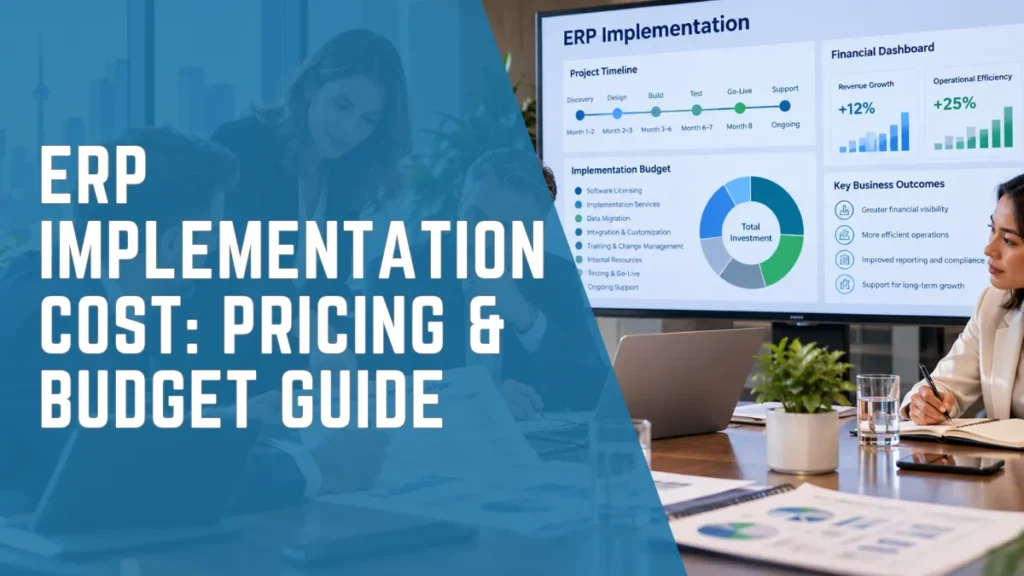
Understanding the full ERP implementation cost is essential for organizations planning to modernize their financial and operational systems. While software licensing represents one part of the investment, implementation expenses can also include consulting services, data migration, integrations, customization, employee training, and ongoing support.
ERP implementation costs vary depending on organizational complexity, software requirements, and project scope. For CFOs and finance leaders, developing a realistic budget requires understanding both the initial investment and the long-term total cost of ownership.
This guide breaks down the major ERP implementation cost categories, explains what influences pricing, and provides practical budgeting considerations to help organizations evaluate proposals and make informed investment decisions.
How Much Does ERP Implementation Cost?
ERP implementation costs can vary significantly depending on the software platform, organizational size, business requirements, and project complexity.
Industry estimates place ERP implementation projects anywhere from approximately $25,000 to over $1 million, although larger enterprise deployments can exceed this range. These figures are broad market estimates, not specific pricing for Sage Intacct, Sage 300, or Sage X3.
For organizations evaluating ERP investments, implementation costs generally depend on:
- Project scope: The number of business processes, departments, and locations involved.
- Software complexity: The ERP modules and capabilities required.
- Data migration: The volume, quality, and complexity of existing business data.
- Integrations: Connections with CRM, payroll, inventory, and other applications.
- Customization: Specialized workflows, reports, or system extensions.
- Training and deployment: Employee onboarding, testing, and go-live support.
A realistic ERP implementation budget should account for both the initial deployment and the ongoing expenses associated with operating and supporting the system.
The most reliable way to determine ERP implementation cost is to complete a structured assessment of business requirements and obtain a detailed implementation proposal.
What Is Included in ERP Implementation Cost?
ERP implementation cost includes the expenses associated with preparing, configuring, deploying, and supporting an enterprise resource planning system.
While software licensing is an important consideration, it does not represent the full cost of implementing an ERP solution.
A comprehensive budget should account for the following:
← Swipe left or right to view the full table →
| Cost Category | What It Covers |
|---|---|
| Software licensing | Subscriptions, user access, modules, and licensing requirements |
| Implementation services | Discovery, configuration, project management, and deployment |
| Data migration | Data cleansing, mapping, transfer, and validation |
| System integration | Connecting ERP with CRM, payroll, ecommerce, and other systems |
| Customization | Business-specific workflows, reporting, and system extensions |
| Training and change management | Employee training, documentation, and adoption support |
| Internal project resources | Staff time, management involvement, and operational coordination |
| Testing and deployment | System testing, cutover planning, and go-live activities |
| Ongoing support | Troubleshooting, maintenance, optimization, and enhancements |
The total investment depends on the organization’s business processes, industry requirements, existing technology environment, and implementation scope.
Understanding these cost categories helps finance leaders evaluate implementation proposals, identify potential budget gaps, and plan for both initial and recurring expenses.
1. ERP Software Licensing and Subscription Costs
ERP software pricing varies depending on the selected platform, number of users, required modules, and licensing arrangement.
Cloud-based ERP systems commonly use subscription pricing, while other deployment options may involve different licensing, infrastructure, and maintenance requirements.
When evaluating software costs, organizations should consider:
- Number and type of users requiring ERP access
- Financial management and operational modules
- Additional entities, departments, or locations
- Subscription renewal terms and potential price changes
- Third-party applications and related licensing
- Future requirements as the organization grows
For example, a professional services organization focused on financial reporting and multi-entity accounting may have different requirements than a manufacturer managing inventory, production, and supply chain operations.
Finance leaders should evaluate both initial software expenses and recurring licensing commitments to understand the long-term investment.
2. ERP Implementation and Consulting Services
ERP implementation services help organizations translate business requirements into a configured and operational ERP environment.
These services typically involve collaboration between the implementation partner, finance leadership, IT teams, and operational stakeholders.
Common activities include:
- Business requirements gathering and discovery
- Current-state process assessment
- ERP solution design and configuration
- Project planning and management
- Financial and operational workflow setup
- System testing and deployment preparation
- Go-live coordination and initial support
Implementation costs are influenced by the scope and complexity of the project.
For example, an organization implementing standardized financial processes may require less configuration than a multi-location business with complex inventory, reporting, and operational workflows.
Before approving a proposal, finance leaders should confirm which services are included, the expected deliverables, and how additional work will be priced.
Clearly defined implementation requirements can help reduce scope changes and support more predictable project spending.
3. Data Migration and Data Preparation Costs
Data migration is an important part of ERP implementation, particularly for organizations moving from legacy accounting systems, spreadsheets, or disconnected applications.
The process involves more than transferring information into a new platform. Existing records must be reviewed and prepared to support accurate reporting and reliable operations.
Typical data migration activities include:
- Reviewing historical financial records
- Cleaning customer, vendor, and inventory data
- Identifying duplicate or incomplete information
- Mapping existing data to the new ERP structure
- Migrating opening balances and selected historical transactions
- Validating migrated records
- Reconciling financial and operational information
The complexity of these activities depends on the quality, volume, and structure of existing data.
For organizations with multiple systems or inconsistent records, data preparation may require additional time and resources.
CFOs should determine which historical records must be migrated, which information can be archived, and how data accuracy will be verified before go-live.
Establishing these expectations early can help prevent additional expenses during implementation.
4. System Integration and Customization Costs
ERP systems often need to exchange information with applications used across finance, sales, operations, and human resources.
Integration requirements may include connections to:
- Customer relationship management systems
- Payroll and human resources applications
- Ecommerce and point-of-sale platforms
- Inventory and warehouse management applications
- Business intelligence and reporting tools
- Banking and payment systems
The cost of integration depends on the number of applications, compatibility, data exchange requirements, and availability of standard connectors.
Some organizations may also require custom workflows, specialized reports, or additional functionality that cannot be addressed through standard configuration.
However, extensive customization may increase implementation costs and create additional maintenance requirements.
Organizations should first evaluate whether standard ERP capabilities can support their business processes before investing in custom development.
This approach can help control ERP project costs while supporting future system upgrades and scalability.
5. Employee Training and Change Management Costs
ERP implementation introduces changes to how employees perform tasks, access information, and coordinate business processes.
Without adequate training, organizations may experience inconsistent system adoption, processing errors, and continued reliance on spreadsheets or manual workarounds.
An ERP implementation budget should account for:
- Role-based employee training
- Process documentation and user guides
- Communication about upcoming workflow changes
- Training for department leaders and key users
- Employee participation in testing
- Additional support during the transition
Training requirements will vary across departments.
Finance teams may need guidance on reconciliations, financial reporting, and month-end close processes. Operations teams may require training on purchasing, inventory management, or production workflows.
Employee training should focus on both system functionality and the business processes the ERP implementation is intended to improve.
6. Internal Project Resources and Operational Costs
Internal employee time is an important ERP implementation expense that may not appear in a software vendor’s proposal.
Even when an implementation partner manages configuration and deployment, the organization must provide business knowledge, make decisions, and validate that the system meets operational requirements.
Internal responsibilities may include:
- Participating in discovery and planning sessions
- Documenting current workflows
- Preparing and validating data
- Reviewing system configuration
- Performing user acceptance testing
- Supporting employee training
- Approving deployment readiness
CFOs, Controllers, IT Directors, and operations managers may need to dedicate time to these activities while maintaining their regular responsibilities.
Organizations should assess whether existing teams have sufficient capacity or whether temporary support and workload adjustments will be necessary.
Including these resource requirements provides a more accurate picture of ERP implementation cost.
7. Testing, Go-Live, and Ongoing Support Costs
Before an ERP system becomes operational, organizations need to confirm that key financial and business processes function as intended.
Testing and deployment expenses may include:
- Functional and integration testing
- User acceptance testing
- Financial reconciliation and reporting validation
- Cutover planning and deployment coordination
- Go-live troubleshooting
- Post-implementation stabilization support
Costs may continue after the initial deployment.
Organizations should also consider software subscriptions, technical support, system enhancements, additional training, and future integration requirements.
These recurring expenses are important when assessing the ERP system’s total cost of ownership.
What Factors Affect ERP Implementation Cost?
ERP implementation costs can vary significantly even when organizations select the same software platform.
Key factors include organizational size, industry requirements, existing system complexity, data quality, customization needs, and implementation timelines.
Understanding these factors allows CFOs to evaluate project requirements more accurately and compare implementation proposals based on scope rather than price alone.
Business Size and Organizational Complexity
The number of users, departments, locations, and legal entities can affect ERP configuration and deployment requirements.
Organizations managing multiple entities may require additional financial consolidation, reporting, and intercompany transaction capabilities.
Industry and Operational Requirements
Different industries have different ERP needs.
A nonprofit organization may prioritize financial reporting, fund tracking, and accountability, while a manufacturing business may need inventory management, production planning, and product costing.
Existing Technology and Data Quality
Organizations operating with multiple disconnected applications may require more extensive data migration and integration work.
Poor data quality can also increase the resources needed to prepare and validate information.
Customization Requirements
Specialized workflows and reporting requirements may increase the scope of implementation.
Organizations should evaluate whether these requirements are necessary and whether they can be addressed through standard system configuration.
Implementation Timeline and Deployment Approach
A phased implementation may distribute work and expenses across several stages, while a broader deployment may require more resources during a shorter period.
The appropriate approach depends on project priorities, business readiness, and operational dependencies.
Common ERP Implementation Costs That Are Easy to Overlook
Even a detailed ERP proposal may not capture every expense an organization will incur during implementation.
Some costs arise from internal operational demands, unexpected technical requirements, or activities that fall outside the agreed scope of services.
Finance leaders should pay particular attention to:
- Temporary staffing or workload adjustments: Additional resources may be needed when employees divide their time between implementation activities and regular responsibilities.
- Data cleansing and preparation: Incomplete, inconsistent, or duplicated information may require more extensive preparation than initially expected.
- Third-party integration expenses: External applications may require additional connectors, licensing, development, or ongoing maintenance.
- Operational disruption during transition: Training, testing, and workflow adjustments may temporarily affect employee productivity.
- Post-go-live optimization: Additional configuration, reporting improvements, and user support may be necessary after deployment.
These expenses do not affect every ERP project equally. Their impact depends on system complexity, organizational readiness, and the responsibilities included in the implementation agreement.
CFOs should review project assumptions, exclusions, and internal resource requirements before finalizing the ERP implementation budget.
ERP Implementation Cost Considerations for Canadian Businesses
Canadian organizations may face additional budgeting requirements depending on their business structure, industry, and operating locations.
Finance leaders should assess these considerations during ERP planning rather than assuming that a standard implementation scope will address every requirement.
Canadian Tax and Financial Reporting Requirements
Organizations should evaluate how the ERP system will support applicable Canadian sales taxes, financial reporting requirements, and internal controls.
Depending on the provinces in which a business operates, requirements may involve GST/HST, provincial sales taxes, or Quebec sales tax.
Implementation costs may be affected by the configuration, testing, and reporting requirements associated with these obligations.
Multi-Entity and Cross-Border Operations
Organizations operating across provinces or internationally may need additional capabilities for financial consolidation, intercompany transactions, and multi-currency reporting.
Businesses with Canadian and US operations should consider how currency conversion, reporting structures, and accounting requirements will be managed.
These requirements can influence configuration, integration, and testing efforts.
Software Pricing and Currency Considerations
Canadian finance leaders should confirm whether software licensing, consulting services, and third-party applications are quoted in Canadian or US dollars.
Foreign exchange fluctuations, applicable taxes, contractual renewal terms, and payment schedules may affect the overall ERP budget.
Clarifying these details before signing an agreement supports more accurate financial planning.
How to Build a Realistic ERP Implementation Budget
A well-structured ERP implementation budget should connect project spending with the business outcomes the organization expects to achieve.
Finance and operations leaders can use the following approach.
Step 1: Define the Business Objectives
Identify the financial and operational challenges the ERP implementation should address.
These may include lengthy month-end close processes, limited reporting visibility, manual data entry, inconsistent inventory records, or disconnected systems.
Clear objectives help determine which ERP capabilities and implementation services should receive priority.
Step 2: Define the Implementation Scope
Document the departments, users, locations, modules, integrations, and data migration requirements included in the project.
Separate essential functionality from capabilities that could be introduced during later phases.
Step 3: Request a Detailed Implementation Proposal
Ask prospective ERP implementation partners to provide an itemized scope of work.
The proposal should identify deliverables, responsibilities, project assumptions, timelines, and exclusions.
Finance leaders should also confirm whether services are provided on a fixed-fee or time-and-materials basis and how changes in scope will be approved.
Step 4: Estimate Internal Resource Requirements
Determine how much time employees will need to dedicate to discovery, configuration reviews, data validation, testing, and training.
Consider whether additional resources will be required to maintain daily operations during implementation.
Step 5: Include a Project Contingency
ERP projects may encounter unexpected data quality issues, integration requirements, or scope changes.
A contingency allowance helps organizations prepare for these possibilities.
The amount should reflect project complexity, uncertainty, and organizational risk tolerance rather than relying on a fixed percentage for every implementation.
Step 6: Evaluate the Total Cost of Ownership
ERP total cost of ownership includes both initial implementation spending and expected expenses over the system’s useful operating period.
A multi-year financial assessment should consider licensing, support, maintenance, infrastructure where applicable, future enhancements, and additional users or modules.
This helps decision-makers understand the long-term financial commitment.
ERP Implementation Budget Checklist for CFOs
The following checklist can help finance leaders review whether the major cost categories have been included before approving an ERP implementation proposal.
← Swipe left or right to view the full table →
| Budget Component | Expense Type | Budget Consideration |
|---|---|---|
| ERP software licensing | Upfront or recurring | Users, modules, subscriptions, and renewal terms |
| Implementation consulting | Primarily one-time | Discovery, configuration, project management, and deployment |
| Data migration | Primarily one-time | Cleansing, mapping, transfer, and validation |
| System integration | Initial and potentially ongoing | Third-party connections and maintenance |
| Customization | Initial and potentially ongoing | Specialized workflows, reports, and extensions |
| Employee training | Initial and ongoing | Training sessions, documentation, and adoption support |
| Internal project resources | Project-related | Employee time and workload adjustments |
| Testing and deployment | Primarily one-time | Validation, cutover, and go-live support |
| Post-go-live support | Initial and recurring | Troubleshooting, maintenance, and optimization |
| Future enhancements | As needed | Additional functionality, users, and integrations |
| Project contingency | Budget reserve | Unanticipated requirements and approved scope changes |
A useful budgeting approach is to separate one-time implementation expenses from recurring operational costs and internal resource commitments.
This provides greater transparency when comparing proposals and planning cash requirements.
ERP Implementation Cost vs. Long-Term Business Value
For CFOs and finance leaders, evaluating ERP implementation costs should involve more than identifying the lowest upfront quote.
An implementation proposal with a lower initial price may exclude important services such as data migration, system integration, employee training, or post-go-live support. These exclusions can increase the overall investment or create additional demands on internal resources.
A more effective approach is to evaluate the total cost of ownership alongside the expected financial and operational improvements the ERP system is intended to deliver.
Measuring ERP Implementation Value
Organizations should establish measurable performance indicators that connect ERP investments with their business objectives.
Potential indicators include:
← Swipe left or right to view the full table →
| Business Area | Example Performance Indicator |
|---|---|
| Financial management | Days required to complete month-end close |
| Financial reporting | Time needed to prepare management reports |
| Accounts payable | Invoice processing time and manual approval effort |
| Inventory management | Inventory accuracy and reconciliation frequency |
| Procurement | Purchase order processing time |
| Manufacturing | Production schedule adherence and cost visibility |
| Operational efficiency | Reduction in manual processing activities |
| Employee adoption | Completion of transactions using approved ERP workflows |
Organizations should establish baseline measurements before implementation and monitor results after deployment.
For example, if an organization expects ERP automation to reduce manual reporting, finance leaders can compare reporting preparation time before and after implementation.
This approach helps evaluate whether the investment is delivering measurable value rather than focusing only on the initial software and implementation price.
How Does ERP Solution Selection Affect Implementation Cost?
ERP implementation costs also depend on the capabilities and operational requirements associated with the selected platform.
For organizations evaluating Sage solutions, Sage Intacct, Sage 300, and Sage X3 address different business needs.
Sage Intacct: Financial Management and Multi-Entity Reporting
Sage Intacct is designed for organizations seeking cloud-based financial management, automation, reporting, and multi-entity accounting capabilities.
Implementation considerations may include:
- Financial structure and chart of accounts configuration
- Multi-entity reporting requirements
- Accounts payable and receivable workflows
- Financial dashboards and reporting
- Integrations with existing business applications
Organizations with complex consolidation or reporting requirements may need additional configuration and consulting services.
Sage 300: Financial and Operational Management
Sage 300 supports accounting and business management requirements for organizations that need financial management and operational functionality.
Implementation or modernization considerations may include:
- Existing financial workflows and configurations
- Inventory and order management requirements
- Reporting and integration needs
- Third-party applications and customizations
- Data migration and system continuity requirements
For organizations already using Sage 300, the budget may involve upgrading or optimizing the existing environment rather than replacing the platform.
Sage X3: Manufacturing, Distribution, and Complex Operations
Sage X3 supports organizations with more complex financial, manufacturing, distribution, and supply chain requirements.
Implementation considerations may include:
- Production planning and manufacturing processes
- Inventory and warehouse management
- Purchasing and supply chain workflows
- Multi-site or multi-entity operations
- Product costing and operational reporting
- Integration between finance and operations
These requirements may involve broader cross-functional participation and more extensive process design.
When evaluating ERP implementation pricing, organizations should compare solutions based on the business requirements they need to support rather than software pricing alone.
Frequently Asked Questions About ERP Implementation Cost
How much does ERP implementation cost?
ERP implementation cost varies depending on the software selected, number of users, business complexity, required modules, integrations, and implementation services. A detailed assessment of business requirements is the most reliable way to develop an accurate cost estimate.
What are the biggest expenses in an ERP implementation?
Major ERP implementation expenses commonly include software licensing, consulting and configuration, data migration, integrations, employee training, and internal project resources. The relative cost of each category depends on the organization’s requirements and implementation scope.
Is ERP implementation cost separate from software licensing?
Yes. Software licensing covers access to or use of the ERP platform, while implementation services involve configuring, integrating, testing, and deploying the system. Both should be included in the overall ERP budget.
What hidden ERP implementation costs should CFOs consider?
Frequently overlooked expenses include data cleansing, internal employee time, specialized reporting, third-party integrations, additional training, temporary operational support, and post-launch enhancements.
How can organizations reduce ERP implementation costs?
Organizations can help control costs by defining clear requirements, preparing accurate data, limiting unnecessary customization, prioritizing essential functionality, and establishing effective project governance. A phased implementation may also help manage spending and internal resources.
Should ongoing support be included in the ERP budget?
Yes. Ongoing support, software subscriptions, maintenance, training, and future enhancements should be considered when assessing the ERP system’s total cost of ownership.
What factors influence ERP implementation pricing in Canada?
Factors include organizational size, business complexity, industry requirements, data migration needs, system integrations, and implementation scope. Canadian businesses should also consider applicable tax configurations, multi-currency requirements, and whether services are quoted in Canadian or US dollars. Lorem ipsum dolor sit amet, consectetur adipiscing elit. Ut elit tellus, luctus nec ullamcorper mattis, pulvinar dapibus leo.
How should CFOs evaluate ERP implementation ROI?
CFOs should compare the total cost of ownership with measurable improvements in financial reporting, process efficiency, inventory accuracy, automation, and operational visibility. Establishing performance baselines before implementation makes it easier to assess results after deployment.
Get a Clearer Picture of Your ERP Implementation Costs
Planning an ERP implementation requires more than comparing software prices. A realistic budget should account for your organization’s business requirements, implementation complexity, internal resources, and long-term operational needs.
IWI Consulting Group helps Canadian organizations evaluate ERP requirements and plan implementations involving Sage Intacct, Sage 300, and Sage X3.
Whether you’re replacing an outdated system, improving financial visibility, or supporting more complex business operations, understanding the full scope of implementation costs can help you make informed investment decisions.
Get an ERP Implementation Cost Assessment?
Talk with IWI Consulting Group about your business requirements, implementation scope, and budget considerations.