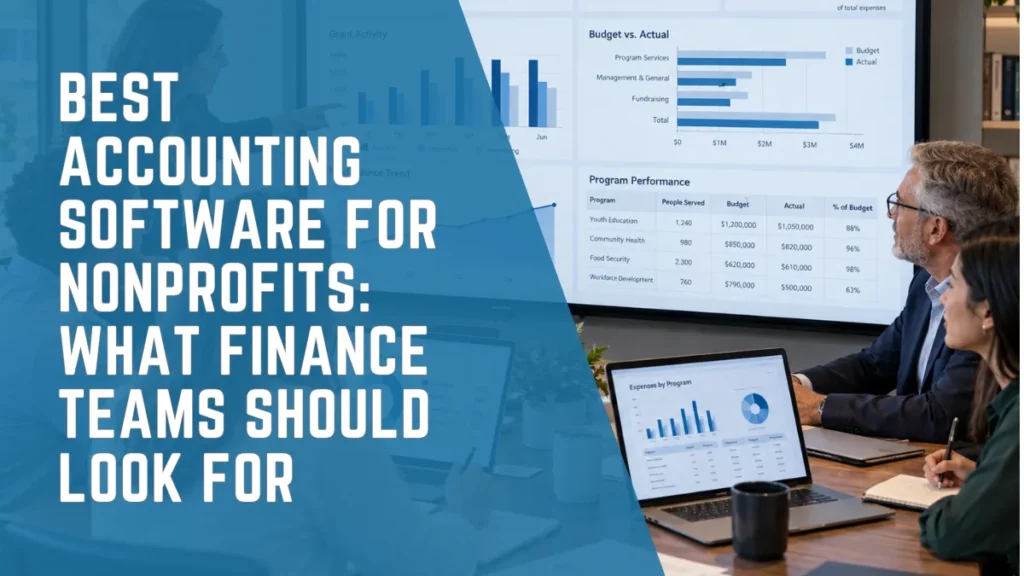
Choosing the best accounting software for nonprofits involves more than comparing features or subscription costs. Nonprofit finance teams must manage restricted funds, track grants, monitor program spending, maintain financial controls, and provide reliable reporting to boards, donors, funders, and other stakeholders.
As organizations grow, those responsibilities can become increasingly difficult to manage through basic accounting systems and disconnected spreadsheets.
A smaller nonprofit with a limited number of programs may have straightforward accounting requirements. However, organizations managing multiple grants, funding sources, locations, or legal entities often need greater reporting flexibility, automation, and financial visibility.
For CFOs, Controllers, Finance Directors, and Executive Directors, the evaluation should begin with the organization’s financial complexity and long-term operational requirements.
This article explores the capabilities nonprofit finance teams should prioritize, the questions to ask when evaluating vendors, and when a financial management platform such as Sage Intacct may be an appropriate solution.
What Is Nonprofit Accounting Software?
Nonprofit accounting software is a financial management system that supports the accounting, reporting, and financial control requirements of nonprofit organizations.
Like commercial businesses, nonprofits need core accounting functionality, including general ledger management, accounts payable, accounts receivable, cash management, and budgeting.
However, nonprofit financial reporting often requires additional detail.
Finance teams may need to understand:
- Which financial resources are restricted or unrestricted
- How grant funds are allocated and spent
- Whether program expenses remain within budget
- Which funding sources support specific activities
- How departments, programs, and locations perform financially
- What information must be presented to boards, donors, funders, and auditors
Nonprofits must also consider applicable accounting standards and reporting requirements.
For example, Canadian not-for-profit organizations applying Accounting Standards for Not-for-Profit Organizations (ASNPO) may use the deferral method or restricted fund method of accounting for contributions, as applicable.
In the United States, nonprofit financial reporting follows relevant Financial Accounting Standards Board (FASB) requirements, including the accounting treatment of contributions and donor-imposed restrictions.
Therefore, choosing the right nonprofit accounting platform requires an understanding of both organizational needs and applicable financial reporting obligations.
Modern nonprofit financial management software should help organizations manage those requirements while reducing unnecessary complexity and manual processes.
Why Choosing the Right Nonprofit Accounting Software Matters
Accounting software influences much more than bookkeeping efficiency.
For nonprofit finance leaders, the financial system supports budgeting, program oversight, grant management, compliance, reporting, and strategic decision-making.
When the accounting platform no longer supports these responsibilities effectively, finance teams often create additional processes outside the system.
For example, staff may export financial information into spreadsheets to prepare board reports, calculate grant balances, allocate shared expenses, or consolidate results across multiple entities.
Although these workarounds may initially seem manageable, they can become increasingly difficult to maintain.
Common consequences include:
- Longer month-end reporting cycles
- Increased spreadsheet dependency
- Limited visibility into program and grant performance
- More manual reconciliation and data entry
- Difficulty maintaining consistent financial information
- Greater administrative effort during audits
- Delayed access to financial information for leadership
The right accounting platform should reduce these challenges by providing a stronger foundation for financial management.
Rather than evaluating software only on basic transaction processing, nonprofit finance teams should consider how effectively each solution supports the organization’s complete financial processes.
What Types of Accounting Software Should Nonprofits Consider?
Before comparing individual products, nonprofit finance teams should understand the main categories of accounting software available.
Different platforms serve different levels of financial and operational complexity.
Swipe left or right to view the full table →
| Software Category | Typical Capabilities | Potential Fit |
|---|---|---|
| Entry-level accounting software | General ledger, invoicing, expense tracking, basic financial statements, and standard reporting | Smaller nonprofits with relatively straightforward accounting requirements |
| Nonprofit-focused accounting software | Fund tracking, nonprofit reporting, budgeting, and other specialized financial functions, depending on the platform | Organizations with nonprofit-specific requirements that may not need an extensive financial management environment |
| Advanced cloud financial management software | Dimensional accounting, grant management, flexible reporting, workflow automation, integrations, and potentially multi-entity consolidation | Growing nonprofits managing more complex funding structures, programs, and reporting requirements |
For example, products such as QuickBooks may meet the accounting requirements of some smaller nonprofit organizations, particularly when their reporting needs remain relatively simple.
Other nonprofits may prefer specialized fund accounting solutions designed around nonprofit financial processes.
Organizations requiring more sophisticated reporting, grant accounting, dimensional analysis, or multi-entity management may evaluate advanced financial management platforms such as Sage Intacct.
The objective is not to select the most feature-rich platform. It is to choose the system that fits the organization’s financial requirements, resources, and expected growth.
A structured assessment can help finance teams identify the appropriate category before evaluating specific vendors.
1. Start With Fund Accounting and Restriction Tracking
Fund and restriction tracking should be among the first capabilities nonprofit finance teams evaluate.
Unlike commercial organizations that primarily focus on profitability, nonprofits frequently need to demonstrate how financial resources are received, allocated, and used according to donor restrictions, grant agreements, and organizational purposes.
Depending on the organization’s reporting requirements, useful capabilities may include:
- Tracking restricted and unrestricted resources
- Monitoring financial activity by fund
- Associating revenue and expenses with programs
- Tracking grants and funding sources
- Managing internally designated funds
- Reporting by department, location, or project
- Separating financial activity without creating an excessive number of general ledger accounts
The accounting structure should allow finance teams to identify where resources originated, how they may be used, and what remains available.
Why dimensional accounting matters
Some accounting systems require organizations to create additional general ledger accounts to represent combinations of funds, programs, grants, and departments.
As reporting requirements increase, this approach can make the chart of accounts difficult to maintain.
Dimensional accounting provides another approach by allowing transactions to be categorized using attributes such as fund, grant, program, department, location, or entity.
Sage Intacct supports dimensional financial management, which can help nonprofits analyze financial activity across multiple categories without depending entirely on increasingly complex account structures.
Organizations evaluating this approach should determine how their financial dimensions would be configured to support their reporting requirements.
2. Evaluate Grant Accounting and Management Requirements
Grant-funded organizations often require more advanced financial tracking than standard accounting systems provide.
Grant accounting may involve monitoring multiple funding awards, each with different budgets, reporting periods, restrictions, reimbursement requirements, and spending conditions.
The accounting platform should make it practical to manage these requirements without relying heavily on separate spreadsheets.
Important capabilities may include:
- Grant budget tracking
- Grant-specific reporting periods
- Budget-to-actual analysis
- Eligible and reimbursable expense tracking
- Indirect cost allocation
- Grant billing
- Funding limits and restrictions
- Supporting documentation
- Grant-related financial reporting
For example, a grant may begin halfway through an organization’s fiscal year and continue into the following year.
Finance teams should be able to monitor activity across the grant’s reporting period without rebuilding financial reports manually.
Questions to ask during software evaluation
- Can the system track each grant independently?
- Can transactions be assigned directly to specific grants?
- Can finance teams compare grant budgets with actual expenses?
- Can grant reporting periods differ from the fiscal year?
- Can reimbursable costs and indirect expenses be identified?
- Can multiple funding sources support the same program?
- Can grant managers access financial information without extensive spreadsheet preparation?
Sage Intacct offers nonprofit grant accounting capabilities, including grant-related financial tracking, reporting, and billing functionality.
However, organizations should confirm that the specific features and configuration options available meet their grant requirements.
The goal is not simply to record grant activity but to improve financial oversight throughout the life of each grant.
3. Prioritize Flexible Financial Reporting
Financial reporting is one of the most important considerations when evaluating nonprofit accounting software.
Standard financial statements remain essential, but nonprofit leaders often require additional views of financial information.
For example, a CFO may need consolidated financial statements for the board, while program managers require detailed spending reports for their individual programs.
Similarly, a grant manager may need financial information for a specific funding award, while department leaders need budget-to-actual reports.
The accounting platform should support these reporting requirements without requiring finance staff to repeatedly export and manipulate financial information.
Important reporting dimensions
Swipe left or right to view the full table →
| Reporting View | Financial Question |
|---|---|
| Fund | How much remains available within a specific fund? |
| Grant | How much has been spent against a particular funding award? |
| Program | What does it cost to operate each program? |
| Department | Which departments are above or below budget? |
| Location | How are individual offices or facilities performing? |
| Entity | What is the financial position of each legal entity? |
| Funding source | How are specific funding sources being used? |
| Project | What is the financial status of a particular initiative? |
In addition to flexible reporting, finance teams should assess whether users can investigate underlying transactions through drill-down capabilities.
For instance, a Finance Director reviewing an unexpected program expense should be able to investigate the transactions contributing to the variance without rebuilding the report.
Sage Intacct supports customizable reports, dashboards, and dimensional analysis that can help nonprofit finance leaders examine information across relevant financial categories.
The reporting structure should be designed around the organization’s actual management and stakeholder requirements.
4. Look for Timely Financial Visibility
Financial information becomes less useful when decision-makers receive it too late.
In some nonprofits, monthly reporting depends on manual exports, spreadsheet consolidation, reconciliations, and repeated formatting.
This process may delay the information leadership needs to make decisions about spending, staffing, funding, and program operations.
Modern nonprofit accounting software should help organizations access timely financial information through dashboards and reporting tools.
Depending on the platform and configuration, useful dashboard metrics may include:
- Revenue and expenses
- Cash balances and cash flow
- Budget variances
- Grant utilization
- Program spending
- Funding trends
- Accounts payable and receivable
- Financial ratios
- Department and entity performance
However, dashboards are only as useful as the financial information supporting them.
Accurate transaction coding, appropriate accounting structures, reliable integrations, and consistent processes remain essential.
Sage Intacct offers configurable dashboards and financial reporting capabilities that can help authorized users monitor relevant financial information.
For nonprofit leadership, the value lies in gaining timely information that supports operational and strategic decisions.
5. Assess Budgeting, Planning, and Forecasting
Budgeting is central to nonprofit financial management.
Organizations must often allocate limited resources across programs, grants, departments, and operational priorities while responding to changes in funding and expenses.
However, budgeting processes can become complicated when information is distributed across multiple spreadsheets.
Finance teams may spend significant time collecting department budgets, consolidating revisions, and comparing actual performance against approved plans.
When evaluating accounting software, organizations should consider support for:
- Annual and departmental budgets
- Program and grant budgets
- Budget revisions
- Budget-to-actual reporting
- Rolling forecasts
- Multiple planning scenarios
- Collaborative budget preparation
- Approval workflows
The relationship between planning and actual financial results is particularly important.
Finance leaders should be able to understand variances, identify emerging financial pressures, and adjust forecasts as organizational circumstances change.
Sage offers Sage Intacct Planning as a complementary solution for budgeting, planning, and forecasting.
Nonprofits evaluating Sage Intacct should determine whether the core budgeting capabilities meet their requirements or whether additional planning functionality would provide value.
6. Examine Financial Process Automation
Automation can reduce repetitive administrative work while improving the consistency of financial processes.
However, nonprofit finance teams should evaluate automation based on practical business outcomes rather than the number of features advertised.
The most useful automation opportunities typically involve processes that are repetitive, time-consuming, or prone to manual errors.
Potential areas include:
- Accounts payable processing
- Purchase and expense approvals
- Journal entry workflows
- Recurring transactions
- Financial allocations
- Grant billing
- Revenue recognition
- Inter-entity transactions
- Reporting processes
For example, a nonprofit may need to allocate shared administrative expenses across multiple programs or grants.
When these calculations are performed manually, finance teams must repeatedly prepare spreadsheets, validate allocation percentages, and record the resulting entries.
Appropriately configured allocation workflows can improve consistency and reduce repetitive work.
Sage Intacct supports various financial automation capabilities, including accounts payable workflows and allocation functionality.
However, automation should follow a review of existing processes.
An implementation partner should help determine which workflows should be standardized, simplified, or redesigned before they are automated.
7. Consider Multi-Entity and Multi-Location Accounting
Nonprofit organizations sometimes operate through multiple legal entities, foundations, chapters, subsidiaries, or regional offices.
As organizational structures expand, preparing consolidated financial information can become more challenging.
Without an appropriate system, finance teams may need to close individual entities separately, export financial information, reconcile inter-entity transactions, and prepare consolidated reports manually.
Organizations with these requirements should evaluate:
- Entity-level financial reporting
- Consolidated financial statements
- Inter-entity transactions
- Consolidation adjustments and eliminations
- Shared or standardized accounting structures
- Multi-currency functionality
- Location-level reporting
- Centralized financial controls
Sage Intacct provides multi-entity accounting and consolidation capabilities that may be relevant for nonprofits managing complex organizational structures.
However, not every nonprofit needs this functionality.
A single-entity organization with straightforward reporting requirements may find that a simpler accounting solution remains sufficient.
The decision should reflect both the current organizational structure and realistic plans for growth.
8. Review Internal Controls, Permissions, and Audit Readiness
Strong financial controls help nonprofits protect resources, maintain accountability, and support reliable reporting.
Accounting software should provide functionality that supports the organization’s control environment.
Finance leaders should evaluate whether the platform allows appropriate restrictions on access, transaction approvals, and financial responsibilities.
Key questions include:
- Can user access be restricted according to role?
- Can approval workflows be configured?
- Does the system maintain appropriate transaction histories?
- Can transactions be traced to supporting documentation?
- Can financial responsibilities be separated between employees?
- Can management review transactions and exceptions efficiently?
- Can auditors access the information required for their work?
These capabilities can help organizations reduce administrative effort during audit preparation.
However, software functionality alone does not establish strong internal controls.
Organizations must also maintain appropriate financial policies, approval procedures, role assignments, and oversight practices.
The accounting system should reinforce those processes rather than replace them.
9. Evaluate Integrations With Other Nonprofit Systems
Accounting software rarely operates independently.
Many nonprofits use additional applications to manage fundraising, donor relationships, payroll, human resources, grants, banking, and program activities.
When these systems do not exchange information effectively, employees may need to re-enter transactions or depend on recurring spreadsheet imports.
That can increase administrative work and introduce reconciliation challenges.
Before selecting accounting software, finance leaders should identify the systems that must connect with the financial platform.
Common integration requirements may include:
- Fundraising and donor management platforms
- Customer or constituent relationship management systems
- Payroll and HR applications
- Banking systems
- Expense management tools
- Grant management systems
- Payment processing applications
- Budgeting and planning tools
- Program management software
Organizations should determine whether each connection is available through a native integration, third-party connector, API, or custom development.
Sage Intacct provides integration capabilities and supports connections with a range of business applications.
However, integration availability, implementation effort, and ongoing maintenance requirements should be evaluated individually.
The existence of an API does not automatically mean every integration will be straightforward.
10. Determine Whether the Software Can Scale
The accounting platform selected today should support the organization’s reasonably anticipated financial requirements.
Growth can introduce new funding structures, reporting obligations, programs, entities, and transaction volumes.
For example, a nonprofit may begin with a limited number of grants but eventually manage dozens of awards across multiple programs and locations.
Finance leaders should consider whether the software can accommodate:
- Additional grants and funding sources
- New programs and departments
- Increased transaction volumes
- Multiple entities or locations
- More sophisticated reporting
- Additional users and approval roles
- New integrations
- International operations
- Expanded planning requirements
A practical way to assess scalability is to ask vendors to demonstrate future organizational scenarios.
For example:
How would the system handle twice as many grants, two additional legal entities, and new department-level reporting requirements?
This approach provides a clearer picture of scalability than relying solely on general product claims.
The goal is to select software that can support growth without introducing unnecessary cost or complexity.
11. Compare Total Cost of Ownership, Not Just Subscription Price
Cost is an important consideration when choosing nonprofit accounting software.
However, subscription pricing alone does not reflect the full financial commitment.
Organizations should evaluate the total cost of ownership, which may include:
- Software subscriptions
- User licenses
- Additional modules
- Implementation services
- System configuration
- Data migration
- Integrations
- Employee training
- Reporting development
- Ongoing support
- Future system optimization
Finance leaders should also consider the cost of maintaining the current environment.
For example, a lower-cost accounting package may require significant staff time for manual reporting, reconciliations, spreadsheet maintenance, and financial consolidation.
Those activities create operational costs even when the software subscription appears inexpensive.
A more useful financial question
Instead of asking only how much the software costs, nonprofit leaders should consider:
What will it cost to operate the finance function effectively over the next three to five years under each option?
A total cost evaluation should also consider potential improvements in reporting efficiency, financial controls, and staff productivity.
For Sage Intacct, pricing depends on factors such as selected capabilities, users, modules, integrations, and implementation scope.
Organizations should obtain a requirements-based proposal rather than rely on generic pricing assumptions.
12. Assess Implementation and Migration Requirements
Selecting the right accounting platform is only one part of a successful financial system modernization project.
Implementation planning has a direct influence on how effectively the organization can use its new software.
Before migrating, nonprofit finance teams should determine:
- Which historical financial records must be transferred?
- What data requires cleanup?
- How should funds, grants, departments, and programs be structured?
- Does the chart of accounts need redesign?
- Which financial workflows should change?
- Which reports must be available at go-live?
- What integrations are essential?
- How should users be trained?
- What testing and validation procedures are required?
Organizations should also examine existing financial workarounds before recreating them in a new system.
For example, a nonprofit using an entry-level accounting platform may have expanded its chart of accounts to compensate for limited reporting capabilities.
Replicating that structure in a more advanced financial management system may prevent the organization from taking advantage of dimensional reporting.
A well-planned implementation should use the migration process as an opportunity to improve financial workflows, reporting structures, and data quality.
When Has a Nonprofit Outgrown Basic Accounting Software?
Not every nonprofit requires an advanced financial management system.
However, recurring operational challenges may indicate that the current accounting environment is no longer meeting organizational requirements.
Common warning signs include:
- Financial reporting depends heavily on spreadsheets.
- Grant tracking occurs outside the accounting platform.
- The chart of accounts has become difficult to manage.
- Month-end close takes longer than expected.
- Board reporting requires extensive manual preparation.
- Shared expenses must be allocated manually.
- Multiple entities are consolidated through spreadsheets.
- Department leaders cannot access timely budget information.
- Employees repeatedly enter data across different systems.
- Audit preparation requires extensive manual effort.
- Leadership lacks reliable program-level financial visibility.
When several of these problems occur together, improving spreadsheets or adding isolated software tools may not provide a sustainable solution.
The organization may need a more capable financial management platform that centralizes accounting processes and supports more flexible reporting.
Where Sage Intacct Fits for Nonprofit Organizations
Sage Intacct for nonprofits is a cloud-based financial management solution that supports organizations with increasingly complex accounting and reporting requirements.
Its capabilities can be particularly relevant for nonprofit organizations managing multiple programs, grants, funds, reporting dimensions, or legal entities.
Depending on the organization’s configuration and selected functionality, Sage Intacct can support:
- Fund and grant accounting
- Dimensional financial reporting
- Budget-to-actual analysis
- Financial dashboards
- Workflow automation
- Grant-related financial processes
- Multi-entity accounting and consolidation
- Financial allocations
- Integration with other applications
When might Sage Intacct be a strong fit?
Sage Intacct may be worth evaluating when a nonprofit:
- Has outgrown entry-level accounting software
- Manages multiple grants and restricted funding sources
- Needs more flexible financial reporting
- Operates multiple programs, departments, or entities
- Relies heavily on spreadsheets for financial processes
- Requires stronger financial visibility
- Wants to automate repetitive accounting work
- Expects increased financial complexity as it grows
However, the platform may not be necessary for every nonprofit.
Organizations with simpler accounting requirements should assess whether the additional functionality and implementation investment are justified.
Software selection should always begin with a clear understanding of financial processes, reporting expectations, internal resources, and long-term objectives.
Nonprofit Accounting Software Evaluation Checklist
When comparing accounting platforms, nonprofit finance leaders should evaluate both technical capabilities and organizational fit.
The following checklist provides a practical starting point.
Swipe left or right to view the full table →
| Evaluation Area | Questions to Ask |
|---|---|
| Fund accounting | Can the platform track resources according to fund and restriction requirements? |
| Grant accounting | Can grants, budgets, expenses, and reporting periods be managed effectively? |
| Financial reporting | Can users report by fund, program, grant, department, and entity? |
| Dashboards | Can leadership access timely financial information? |
| Budgeting | Can the organization manage budgets, revisions, forecasts, and variances? |
| Automation | Which repetitive financial processes can be automated? |
| Multi-entity accounting | Can the system support consolidation and entity-level reporting? |
| Internal controls | Can access, approvals, and audit trails be configured appropriately? |
| Integrations | Can the platform connect with essential nonprofit applications? |
| Scalability | Can the system support future financial complexity? |
| Migration | How will financial data and historical records be transferred? |
| Implementation | Does the implementation partner understand nonprofit financial requirements? |
| Support | What assistance is available after implementation? |
| Total cost | What are the expected implementation and ongoing operating costs? |
Questions to Ask During Vendor Demonstrations
A product demonstration should show how the accounting system supports real nonprofit financial processes.
Instead of relying only on a standard software presentation, finance teams should ask vendors to demonstrate practical scenarios.
Examples include:
- Show how a restricted fund is tracked from revenue recognition through expense reporting.
- Demonstrate budget-to-actual reporting for an individual grant.
- Generate financial reports by program and funding source.
- Show how shared expenses are allocated across programs.
- Demonstrate how users investigate transactions from financial dashboards.
- Explain how multiple entities are consolidated.
- Show how financial approval workflows are configured.
- Demonstrate integrations with existing applications.
- Explain how a new grant or program would be added.
- Show how reporting requirements can change without rebuilding the chart of accounts.
These demonstrations can help finance leaders determine whether a platform provides the capabilities their organization actually needs.
Why the Implementation Partner Matters
Even a capable accounting platform can underperform when its configuration does not align with organizational requirements.
For nonprofit organizations, implementation decisions influence how funds, grants, programs, departments, and financial processes are represented within the system.
An experienced financial management implementation partner should help translate organizational requirements into a practical system design.
That work may involve:
- Requirements assessment
- Financial process review
- Chart-of-accounts design
- Dimensional structure configuration
- Fund and grant accounting setup
- Workflow automation
- Data migration
- Integration planning
- Financial report configuration
- Testing and training
- Go-live support
- Ongoing system optimization
IWI Consulting Group is a North American ERP consulting and implementation partner with more than 25 years of experience and over 500 successful projects delivered. The firm specializes in Sage solutions, including Sage Intacct, and supports organizations across Canada and the United States with ERP implementation, migration, financial process improvement, reporting, integration, and long-term system optimization.
For nonprofit organizations evaluating Sage Intacct, IWI can help finance leaders assess business and reporting requirements, determine whether the platform is an appropriate fit, and develop an implementation or migration strategy aligned with the organization’s financial processes and long-term objectives.
The objective should not simply be to replace existing accounting software.
A successful implementation should create a financial management environment that supports stronger reporting, operational efficiency, financial controls, and long-term organizational needs.
Choosing the Best Accounting Software for Your Nonprofit
There is no single accounting platform that is automatically right for every nonprofit organization.
The best accounting software for nonprofits is the system that aligns with the organization’s funding structure, reporting requirements, operational complexity, available resources, and expected growth.
For smaller nonprofits with relatively straightforward financial requirements, entry-level accounting software may remain appropriate.
However, organizations managing multiple grants, restricted resources, programs, entities, or extensive reporting obligations may benefit from a more sophisticated financial management platform.
The right solution should help nonprofit finance teams:
- Improve financial visibility
- Reduce manual reporting processes
- Strengthen fund and grant oversight
- Simplify budgeting and planning
- Improve operational efficiency
- Support stronger financial controls
- Provide timely information to leadership
- Adapt to changing organizational requirements
Sage Intacct is one option for organizations that require more advanced nonprofit financial management capabilities.
However, the decision should begin with a structured assessment of financial requirements rather than a predetermined technology choice.
By evaluating the capabilities that matter most, nonprofit leaders can select an accounting platform that supports both effective financial stewardship and long-term mission delivery.
Find the Right Accounting Software for Your Nonprofit
Choosing nonprofit accounting software requires more than comparing product features.
A nonprofit organization needs a financial management solution that supports its funding structure, reporting requirements, operational priorities, and long-term goals.
IWI Consulting Group can help nonprofit finance teams evaluate their current accounting environment, assess whether Sage Intacct is an appropriate fit, and develop a practical implementation or migration strategy.
Whether an organization is struggling with manual reporting, managing increasingly complex grants, or planning to replace an outdated accounting system, a structured assessment can help identify the next steps.
Frequently Asked Questions About Nonprofit Accounting Software
What is the best accounting software for nonprofits?
The best accounting software for nonprofits depends on the organization’s size, funding complexity, grant requirements, reporting needs, and growth plans.
Smaller nonprofits may find that entry-level accounting software meets their requirements. Organizations managing multiple grants, programs, funds, or legal entities may benefit from more advanced financial management systems such as Sage Intacct.
Finance teams should prioritize organizational fit rather than selecting software based solely on popularity.
How much does nonprofit accounting software cost?
Nonprofit accounting software costs vary according to the platform, number of users, required modules, integrations, and implementation scope.
Organizations should consider subscription fees alongside migration, configuration, training, support, and other operating expenses.
A total cost of ownership assessment provides a more complete basis for comparing options.
What features should nonprofit accounting software include?
Important capabilities may include fund accounting, grant tracking, budgeting, flexible financial reporting, internal controls, workflow automation, and integration with other nonprofit applications.
Organizations with more complex requirements may also need dimensional reporting, multi-entity accounting, and financial planning tools.
The appropriate feature set depends on the organization’s funding structure and reporting obligations.
Can nonprofit accounting software manage grants and restricted funds?
Many nonprofit accounting platforms support fund and grant tracking, although the available functionality varies.
More advanced solutions may provide grant-specific budgets, reporting periods, reimbursement tracking, indirect cost allocations, and detailed financial reporting.
Organizations should test their own grant and restriction tracking requirements during software demonstrations.
When should a nonprofit move beyond basic accounting software?
A nonprofit should consider reviewing its accounting platform when financial reporting becomes heavily dependent on spreadsheets, grant tracking requires extensive manual work, or the organization struggles to produce timely financial information.
Additional indicators include complex fund structures, multi-entity accounting requirements, slow reporting processes, and increased financial reporting obligations.
These challenges may indicate that the organization needs a more capable financial management solution.
Is Sage Intacct suitable for growing nonprofit organizations?
Sage Intacct is designed to support organizations with more sophisticated financial requirements, including nonprofits managing multiple funds, grants, programs, locations, and entities.
Its capabilities include dimensional reporting, dashboards, financial automation, and multi-entity accounting.
However, organizations should assess whether its functionality, implementation requirements, and total cost align with their specific needs.